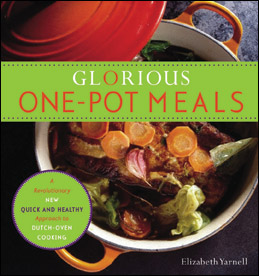
I just returned from shooting two live television appearances this morning — whew! What a whirlwind. And so much fun!
Farmhouse Pasta Glorious One-Pot Meal
I debuted two never-before-demonstrated recipes from the new GOPM cookbook: Farmhouse Pasta (video) and Feta Shrimp with Roasted Tomatoes. At the moment of this posting, I do not see the Colorado & Company video up yet, but it would be worth checking back for it as it will take me a while to edit and post these videos and the recipes on my GOPM site.
Here are some foods that people think are good for them that are really anything but healthy. They’re not the only ones, of course, but perhaps they will surprise you.
1. Yogurt. I’m always surprised that people think of yogurt as a healthy food that’s helpful to eat if you want to lose weight. Our American yogurt is loaded with sugar in the flavorings or fruit added. Truly, it’s much more of a dessert than a main course. Sure, there are probiotics that are good for gut health, but the sugars can spike insulin levels, and there are better ways to get bio-absorbable calcium. Besides, no matter what the dairy lobby would like you to believe, even “fat-free” dairy products are not the dieter’s friend! Personally, I find that eating dairy products is the fastest way to pack on some extra pounds in the blink of an eye.
2. Diet sodas and diet drinks like Crystal Lite. A recent study of over 8,000 women conducted by the University of Austin, TX, concluded that those who drank diet sodas gained more weight over the course of almost a decade than those who don’t. They theorized that the problem lies in the artificial, highly concentrated, and synthetic sweeteners (aspertame, Splenda, etc.) that fool the body into producing insulin and other hormones to digest the sweet flavor, and treat the material as potent sugars that need to be stored in fat cells. Because the body can’t identify these foreign substances, the proper digestive processes are thwarted, and even though these drinks are billed as “low-calorie” or “calorie-free” they should really be called “toxic” and should be considered the antithesis to any health or weight-loss goal!
3. Salmon. Let me specify: any salmon that is not labeled as “wild”, which means that it was farm-raised. Farm-raised salmon — basically any salmon that you pay less than $40/lb for — is not really salmon at all. These genetically-modified fish are grown in over-crowded pens and often fed antibiotics and antiparasitic drugs to combat plagues like sea lice, a scourge of too many fish living too closely together under unnatural conditions. To make their flesh appear pinker and more like the salmon filets we expect, they are often fed dyes which may or may not be hazardous to our health (the jury is still out on that one, regardless of the how heavily the FDA has been lobbied by the salmon aquaculture industry). Some of these mutant fish inevitably escape from their pens and breed with wild salmon populations, weakening and contaminating the remaining schools of wild salmon, which are already disappearing from their native rivers at rates never before seen in this country. But back to how healthy it is to order the $12 salmon filet entree at your local Bennigan’s: expect to get prescription drugs, potentially carcinogenic dyes, and/or genetically-modified cells with your bargain plate.
Many of these toxins are bio-accumulative, and can collect in your cells. Depending upon an individual’s level of tolerance and/or amounts of exposure, constant doses of these foods may result in cancers, food allergies, or even auto-immune diseases, as I believe happened in my case with my own diagnosis of multiple sclerosis and 3 years of hives.
2009 promises to be an exciting year! After 10 years of work, my newest cookbook arrives in stores nationwide in just a few days; I turn 40 in about a month; my husband and I will celebrate out 10th anniversary in July; and later this month will be the 10th anniversary of my diagnosis of multiple sclerosis.
It feels like an appropriate time for some reflection on how I got here. Please indulge me.
Me (on the left) and my friend Jen playing in a waterfall in the Amazon rainforest near Manaus, Brazil, in 1992.
As a teenager, when I thought ahead about my life, I wanted my twenties to be for fun and travel while my 30s would be devoted to a career and family. It pretty much worked out that way, except for the surprise twist that MS threw into the mix. I’m so grateful that I played, dated, and traveled all over the world as a freelance writer and instructional designer in the 1990s when I wasn’t so concerned about or limited by health issues.
Then I met my husband when I was 29 on a chairlift while skiing in Steamboat Springs, CO, and it was love at first sight. We married a year later, in 1999. Looking back, things appeared to be moving ahead right on schedule.
The first decade of the millennium, kicked off by losing sight in one eye 2 weeks before my 30th birthday, started off as a struggle. I hit 2 deer, almost totalled my car, and stopped driving for months. The MS therapies left me bloated, covered in track marks from blown veins, and 30 lbs. heavier in less than a month. For the next three years my body was covered with painful hives that at times were so disfiguring that I couldn’t leave the house for fear of frightening small children.
9/11/2001 began that way for me, as I was homebound that day due to an enormous hive that had expanded my chin to Elmer Fudd proportions. The horror of watching the tragedy unfold was spiked by fear for my sister who was working only blocks away from the World Trade Center that day. It only got worse as I discovered that my childhood friend, Danny Lewin, was on the first plane to hit the towers (though he likely was already dead at that point, the brilliant CEO of Akamai who was raised in Israel and trained in their special forces knew Arabic fluently and was reported as the first one dead on that horrible day when he single-handedly tried to thwart the terrorists and was taken out by a box cutter). But I digress.
Pregnant with my first child in 2002.
This past decade brought my attention to natural health. Between the multiple sclerosis, the hives, bouts with parasites, trying to conceive my first child and then dealing with his severe acid reflux, bowel problems, and resulting sleep issues (he didn’t sleep for years, so neither did I), and the unsatisfactory treatments and answers offered by allopathic medicine, I began to look outside of our Western tradition of medicine – a big leap for the daughter of doctors. I became a Certified Nutritional Consultant and Natural Health Professional.
My new husband, a competitive athlete (a sub-6-minute miler who was once ranked 6th in the world for snowshoeing, among other things), introduced me to organic foods and cooking with whole foods. Together we accidentally invented a way to eat healthily without spending all day in the kitchen. But no one would publish my cookbook about it.
Five frustrating and disappointing years of searching for an agent/publisher culminated in 2005 when I self-published the manuscript no big publisher would touch. Multiple awards and 12,000 copies sold validated my perseverance and brought me to the attention of Broadway Books, a Random House imprint. Fast forward to year and a half later, and here we are, on the eve of the national release of my efforts from the last 10 years.
Can I take a breath yet?
Looking back, I can honestly say that my diagnosis of multiple sclerosis was one of the best things to have happened to me. I am healthier and stronger now than at any other point in my life as a direct result of this diagnosis. I value my husband and my kids more because understand how fragile life and health can be. I have close friends who have been in my life for 20, 30, even 35 years and a tightly-knit extended family. My young children are beautiful, smart, and loving. My marriage is solid and fulfilling.
Because of the MS, I discovered my passions for natural health, food and eating, and helping others. I find it miraculous that I am able to combine my passions into a viable career that allows me to be the kind of mother I want to be while fulfilling my soul. Not much gives me more satisfaction than hearing from people who have changed their lives by cooking with my technique or have benefited from something I’ve written and find themselves healthier for it.
Looking ahead, my hopes for this fifth decade of my life are to further spread my message of better health through better eating through more cookbooks, appearances, classes, writings, etc.; to increase my expertise and knowledge about natural health and nutrition by becoming a naturopathic doctor; to raise healthy and well-balanced children who will become contributing members of our society; and to nurture the love and beauty and joy within my family and in the world.
I intend to continue my own journey toward health and away from the diagnosis of MS while connecting with the MS community and others facing chronic disease conditions through sharing what I have learned that can help them, too.
Of course, my 20-year old self couldn’t have predicted what lay ahead for me, and who knows what curve balls life will throw me next, but I am nothing if not tenacious and determined. I know that I can make my own reality with enough hard work, no matter what the obstacles or twists in the road.
Believe it or not, I have always looked forward to aging and gaining the wisdom that can only come from accumulated experiences. I aim to be the wizened crone with insight into everything from herbs to relationships to new technologies. Not to mention how long I’ve anticipated the day when I won’t get asked for ID when I buy a bottle of wine!
Speaking of wine, let me now raise a glass to you, my blog readers and fans of Glorious One-Pot Meals and natural health, and let’s have a toast to this next phase of our lives together! One of my favorite Irish toasts goes something like this:
May the road rise up to meet you,
and the wind be always at your back.
May 2009 usher in a period of health, joy, love, and prosperity for all of us. L’chaim – to Life!
Reaction from Capitol Hill was swift and sharp. Sen. Patrick Leahy, D-VT., denounced the FDA: “Now, in the administration’s 11th hour, they are quietly trying to water down advisories for women and children about the dangers of mercury in fish, disregarding sound science on this issue. Mercury is a potent neurotoxin capable of impairing childhood development at very low levels.”
And you thought the current administration was done dismantling of policies ennacted to safeguard our food, water, air, and environmental health? No, we will be unraveling the adverse effects for decades to come. Let’s watch what else they try to do in the dusk of their power.
George W. speaks a lot about his legacy and the sale of the health of our nation and of the planet to the industries with the best lobbyists — when we knew better — will certainly be listed among his most wondrous accomplishments.
I’m kicking off my blog tour with a guest post on the CafeMom Food and Party Buzz blog. Check it out for a guaranteed kid-pleasing recipe from my upcoming cookbook — served without anything touching anything else: Garlic Fish!