Elizabeth Yarnell Amazon icon Audible icon Autographed icon Bluesky icon Book Bub icon Buffer icon Booksprout icon Buy Me a Coffee icon URL Copied! Copy URL Email icon Facebook icon Goodreads icon Headphones icon Home icon Instagram icon LinkedIn icon Linktree icon Mastodon icon Patreon icon Periscope icon Pinterest icon Reddit icon RSS icon Search icon Share icon Snapchat icon Threads icon TikTok icon Tumblr icon Twitter icon Vine icon Youtube icon Join a free Q/A Call!

Is Miralax helpful to ease constipation in children?

Pediatrician Dr. Claudia M. Gold calls Miralax a “bandaid” in an article published in today’s Boston Globe. She argues that Miralax doesn’t address the cause behind the constipation even if it can sometimes offer some relief.

I couldn’t agree more. After several long, painful years of trying to help my desperately constipated son with daily doses of Miralax, he wasn’t any closer to regularity and the one thing I knew for sure was that the problem was not a deficiency in Miralax.is miralax safe for kids

For the blissfully uninitiated, as the parent of a chronically constipated child the main advice offered by the mainstream medical community is daily Miralax plus mineral oil orally to make his poop chute slippery.

I couldn’t bring myself to pour mineral oil, a petroleum byproduct, into my son’s little body. I knew the constipation was bringing its own toxicity and the inorganic mineral oil would only add to that toxic load. I chose instead to supplement him with fish oil to help lubricate his pooper.

I clung to the idea that the Miralax, a manmade polymer called Polyethylene Glycol 3350, would help him far longer than I should have, but we were desperate. For him, it might have had some effect early on, but it did not provide a lasting solution. And Dr. Gold says that while Miralax is commonly prescribed for daily use with constipated children, it is only approved for use in adults to begin with. Hmmmph.

In the more holistic health community, we were advised to up his fiber (he eats tons of veggies and fiber supplements only made his constipation worse), increase his water intake (he drinks plenty), remove dairy (he’s been dairy-free for years), take magnesium, fish oil, vitamin E, senna, etc., etc., etc. None of it worked because none of these solutions addressed what turned out to be his real problem: an inflamed colon due to loss of oral tolerance resulting in a multitude of food sensitivities.

Once we identified the 41 (forty-one!) food culprits through MRT testing and changed him to a customized anti-inflammatory diet, the changes were amazing. The constipation eased and pooping became daily and painless for him. Within 2 months he had grown 2.5 inches and gained 15 lbs — giving us a convincing testament that this was finally the right path to help him.

Dr. Gold, unfortunately, does not even mention that food sensitivities could cause constipation. I’m not surprised as the study of food sensitivities is a recent field, and the most modern, high-tech, and reliable testing food sensitivity identification methods are largely unknown to doctors because the testing company decided that rather than investing in an expensive sales force to visit doctor’s offices and convince them of the test’s efficacy, they would choose instead to work with those who already know about nutrition, like Registered Dieticians and Nutritionists, and keep the cost of testing more accessible to those who are suffering.

Now, three years into his “new” way of eating, my son is only constipated when he eats something he shouldn’t have 48 hours previously. The best part is that it no longer requires heroic action from laxatives like Miralax or Ex-lax to address the constipation as it will clear up on its own by the next day if he has been back to eating his safe foods.

Yes, as Dr. Gold points out, there was a psychological element to the constipation as well that had to be addressed concurrently with dietary therapy, but my son’s emotional issues surrounding pooping had a lot more to do with what he was eating and how it made him feel physically than with his need to feel in control of his body as a willful toddler. He literally couldn’t help it.

Is Miralax helpful for addressing constipation in children? Maybe, if used infrequently to address a rare bout of constipation. But viewing it as a “cure” to a kid’s chronic constipation is like slapping a bandaid on a constant rash and pronouncing it cured. Maybe you can cover it up for a time and pretend it has gone away, but if you don’t address the root cause then underneath the problem still remains.

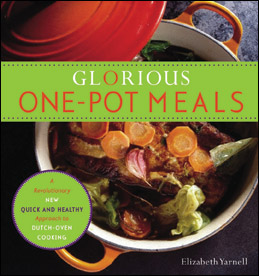
Glorious One-Pot Meals over a campfire?

Reader question: LOVE the recipes! They rock! I used to hate cooking & now I don’t mind! Thnk u. Going camping & wondering: Can I use the dutch oven/recipes over a campfire? If so, do you have any hints for grill or open fire cooking? Thank you! ~ Lisa J., San Diego, CA

Hi Lisa. I’m thrilled to hear you are enjoying Glorious One-Pot Meals! While I’ve never personally prepared GOPMs over a campfire or on a grill, I know readers who do so regularly with great success.

My recommendations:

  • Choose a recipe without dry goods like pasta or rice. I would think a combination like potatoes, meat and veggies with spices would work perfectly. My “Rosemary Chicken” or “Dinner for Dad” GOPM recipes come to mind
  • In a campfire, nestle the Dutch oven into the coals and pile more coals around the sides and on top, so the heat comes from all sides.
  • On a gas grill you can control the temperature and shoot for 450 F with the lid closed. If you are using a charcoal grill, I might suggest you remove the grate and settle the Dutch oven into the coals, as you would in a campfire.
  • Use a non-enameled seasoned cast iron Dutch oven. Although the enamel is fired on at 1400 degrees, much hotter than your typical campfire, I don’t know if it might become discolored or stained if used with coals.

Have you prepared a Glorious One-Pot Meal over a campfire or on a grill? Tell us how it went by leaving a Comment below!

Healing Spices

Last night I went to a class at The Savory Spice Shop in downtown Denver on the healing properties of spices. It was based on the book, Healing Spices: How to Use 50 Everyday and Exotic Spices to Boost Health and Beat Disease by Bharat B. Aggarwal, PhD with Debora Yost.healing spices book by aggarwal

Taught by a graduate of the Nutrition Therapy Institute, the class covered the healing properties of herbs such as turmeric, ginger, chiles, oregano, marjoram, mint, fennel, rosemary, cloves, celery seeds, juniper berries, true cinnamon, and cardamom.

When I got home, my husband asked me if I took over the class — he knows me too well! I felt myself blush and confessed that I really tried not to, although I did offer the class my recipe for one of my stand-by herbal remedies: anti-inflammatory turmeric milk!

Joel Salatin on the cycle of life

Is life fundamentally mechanical or fundamentally biological?

According to Joel Salatin, the inspirational sustainable farmer of Polyface Farms who was featured in Michael Pollan’s influential book, The Omnivore’s Dilemma, the fundamental split in our food industry today is along the line of viewing life as mechanical or biological.

His first advice to anyone wanting to eat more sustainably? Find your kitchen!

A fascinating ChrisMartenson.com podcast that is worth a listen.

Tips for MS and Exercise

I believe in the old adage “Use it or Lose it,” especially when it comes to a degenerative disease like Multiple Sclerosis but really for everyone.

My friend Jan DeCourtney at the Stoll Foundation for Holistic Health co-authored a book with Dr. Walt Stoll called Recapture Your Health in which they outline a recipe for health that includes three elements: 1. diet, 2. exercise, 3. relaxation. If you are working toward achieving a healthy state, this should be your holy trinity.

In a video for Shift.ms, an online community for those with MS, Dr. Monica Marta gives her top 10 tips for exercising when you have a diagnosis of Multiple Sclerosis, but these tips are good for anyone hoping to begin an exercise routine when coming from a less-able place:

  1. Keep active.
  2. Suggested exercises: swimming, nordic walking, dancing.
  3. Start slowly and build up.
  4. Exercise through a relapse.
  5. Don’t push it too hard.
  6. Train to conserve energy so that you can go further.
  7. Warm-up, stretch, and don’t forget the right kind of relaxation.
  8. Incorporate exercise into your life.
  9. Adjust your posture and body alignment.
  10. Manage your expectations.

My favorite of her tips? Just dance! Dancing not only works your body but your brain, too. I’m a regular Jazzerciser, but there are some great videos and video games (Wii, etc.) that can get you moving at home. Best of all: it’s fun!