Elizabeth Yarnell Amazon icon Audible icon Autographed icon Bluesky icon Book Bub icon Buffer icon Booksprout icon Buy Me a Coffee icon URL Copied! Copy URL Email icon Facebook icon Goodreads icon Headphones icon Home icon Instagram icon LinkedIn icon Linktree icon Mastodon icon Patreon icon Periscope icon Pinterest icon Reddit icon RSS icon Search icon Share icon Snapchat icon Threads icon TikTok icon Tumblr icon Twitter icon Vine icon Youtube icon Join a free Q/A Call!

Happy Earth Day! Some Tips to Help the Earth

Happy Earth Day! A few ideas to love your planet earth today and every day:

  • Drive less. Combine your errands and map your route for the most efficient car ride.
  • Use a bike for transportation. Denver has a great B-Cycle system, with bike depots all over the city where you can swipe your card and grab a bike for a few hours, and then drop it off at any other B-Cycle station. There are great bike lanes and off-street, scenic routes you can use to traverse the city by bike.
  • Take a bus. My elementary-school age son would much rather I drive him the six miles to school every day, but as I remind him, the yellow school bus carries ninety kids and my vehicle would only carry a single child… Him riding the school bus is a much better use of our non-renewable resources.
  • Carpool. I am so grateful to the mother that I remembered vaguely from a kindergarten class at a different school four years ago, who approached me and offered to share the driving of our combined kids back and forth to an extracurricular activity. So much of my time seems to be spent as a chauffeur to my kids that reducing the number of car trips benefits in personal as well as environmental ways.
  • Reduce, reuse, recycle. Our goal is to collect less than one bag of garbage each week; everything else gets recycled, reused, or composted. Which leads to the next suggestion:
  • Compost. If you don’t have land to do it on, petition your city to include composting in its citywide recycling program.
  • Eat local. A lot of our food travels 3,000 miles to get to our plates. That’s a lot of petroleum used in transport. Choose foods grown or produced locally when possible. Check out Barbara Kingsolver’s book about spending a year doing just that.
  • Use less water. Water is the oil of the future. It will be easier to invent sustainable energy sources than it will be to find and bring potable water to all the corners of the earth.

More Vegetables in Glorious One-Pot Meals

Just bought your book (Version 1. Didn’t realize there was a revised edition).     Anyway, this seems like a dumb question but the book doesn’t make it clear to me if I always top up recipes with vegetables to fill the dutch oven.     For instance, in the “Glorious Macaroni Cheese”, there are veges already layered in the pot. Do I still fill it to the top with other veges?     Are all recipes topped off to fill the dutch oven with veges in this way? Like, for instance,  ‘Fish Chowder’ or ‘Fish Florentine’.    Thanks for your time.  ~Peter K., Australia

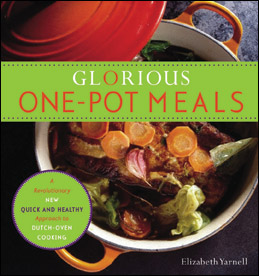
Hi Peter. Thanks for writing! I’m tickled to hear that you recently purchased the 2005 edition of Glorious One-Pot Meals – that went out of print in 2008; now it is definitely a collector’s item.

Your question might be cleared up in the 2009 edition of the cookbook as every recipe in that book benefited from an excellent professional editor courtesy of Random House, but let me see if I can help you out.

Glorious One-Pot Meals seem cook better if the cast iron Dutch oven is filled to the brim. Most of the recipes begin with a layer of grains, then call for protein, and then finish with vegetables. The Glorious Macaroni and Cheese recipe does the same thing, beginning with pasta, only for this one the cheese is interspersed with the veggies, because, after all, it’s cheese.

If you have extra room in your pot, I always recommend filling it with more vegetables than may be called for in the original recipe. Why? Because… why not? Some recipes only call for, say, half of a bell pepper; might as well use it up if you have the space in the pot. Besides, it’s usually a good thing to have more vegetables in one’s life.

Must you always top off your Glorious One-Pot Meal recipes with additional veggies? No, of course not. The Dutch oven doesn’t have to be filled to the brim for the infusion cooking method to work. As long as you follow your nose as to when your meal is ready, you’ll never go wrong.

Be sure to check out the Glorious One-Pot Meals category on this blog for more tips and info on GOPMs, and here’s a video demonstration of one of my favorite recipes, Cajun Fish, to give you a clearer picture of how it all works. Happy cooking!

Can Allergens Be Absorbed Through Your Skin?

Allergens can absolutely be absorbed through the skin. Beyond the obvious topical dermatitis you might get from touching poison ivy, for example, irritants that come into contact with your skin can give you effects that are more than skin deep. Pain, inflammation, fatigue, migraines, nervous system issues… These are all examples of how our bodies may be affected by what we put on our skin.

Don’t forget that our skin is our largest organ and provides a semipermeable barrier between us and everything else. If you are sensitive to something ingested, you’ll want to avoid touching it or smelling it, too. After all, aromas are literally molecules with mass and weight, and even something this small can cause some people to react.

I always discuss personal care and cleaning products with my food sensitivity clients. I had one client with persistent, unexplained shoulder pain who swore by a certain blue topical salve that she thought was giving her relief. She used it 4-5x/day. She finally switched brands after blue dye showed up reactive on her Mediator Release Test (MRT) and the pain went away.

Another example is a client who tested sensitive to citrus fruits on the MRT. When she uses cosmetics or cleansers that contain citric acid, her skin will flare up and react for several days.

I talk to my clients about avoiding aloe in skin care products if they are sensitive to the Lily family and coconut derivatives like sodium lauryl sulfate  if they are sensitive to coconut. We look at scents like vanilla and lemon in soaps, etc., and chemical preservatives like sorbates in shampoos and cleansers. When items like these foods or chemicals turn up high in the MRT, I encourage them to avoid the allergen in every way.

Beyond that, we talk in general about using clean, non-toxic products to lower their overall toxic load.

Your Toxic Threshold

There are some 80,000 chemical compounds in our world that didn’t exist 200 years ago.

We are exposed to chemicals at every turn: in the air we breathe; the water we drink; the soaps, cosmetics, and personal products we use; the foods we eat; and even the clothes we wear.

Everyone has an individual tolerance threshold for toxicity that– once you cross that unknown boundary with too many toxic exposures and too much toxicity built up– can cascade into a variety of symptoms and system malfunctions.

Although we can’t control much of what we’re exposed to, we can work to decrease our personal toxic load by choosing pure foods and clean, non-toxic products whenever possible.

Knowledge is power.

Mira Stainless Steel Container Set for Safe Food Storage

I was excited to receive this Mira Stainless Steel Container Set to try out and review because I’m always looking for safer ways to store leftovers for lunches the next day. Stainless steel and glass won’t leach chemicals into foods, unlike plastic storage containers, but glass can break, which can limit it’s usefulness when you have kids.stainless steel food storage containers These unlined containers are free of BPA, phthalates, PVC and lead.

The three bowls nest for storage and are convenient sizes  for lunch-size portions. The stainless steel is virtually indestructible when tossed into school lunchboxes, and the cheerful lid colors make it easy to identify which one goes with which bowl.stainless steel food storage container

It was fun packing these dinner leftovers into separate bowls for storage and transport, and then combining the ingredients together at lunchtime for a deliciously fresh salad. I find that mixing a salad together at the last minute usually keeps the lettuce crisper than when storing salads already combined together. I know that had I added the sautéed onions and peppers to the lettuce when I packed it the night before, I would have found myself with a soggy salad the next day.

Cleaning these containers is easy: I ran the bowls and non-toxic plastic lids (LDPE number 4 plastic) through the dishwasher on the top rack with no problems.

My only complaint was that sometimes I struggled with getting the plastic lids on and off. However, I often have difficulties in removing lids from jars, opening bottles, etc., and I have an array of opening aids for this purpose. I was able to open and close each bowl every time I tried, but sometimes it took some effort because the plastic lids are so rigid. I had the best luck when I placed the bowl on a counter to open or close the lid. This problem won’t stop me from continuing to use the bowls simply because they are so handy.

If you had these food storage bowls, what would you store in them? Let me know in the comments below, and one lucky winner will receive a free set directly from the company! This giveaway will end on April 18, 2013.