Elizabeth Yarnell Amazon icon Audible icon Autographed icon Bluesky icon Book Bub icon Buffer icon Booksprout icon Buy Me a Coffee icon URL Copied! Copy URL Email icon Facebook icon Goodreads icon Headphones icon Home icon Instagram icon LinkedIn icon Linktree icon Mastodon icon Patreon icon Periscope icon Pinterest icon Reddit icon RSS icon Search icon Share icon Snapchat icon Threads icon TikTok icon Tumblr icon Twitter icon Vine icon Youtube icon Join a free Q/A Call!

Goat Cheese Good for Lactose Intolerance

I wasn’t surprised when I noticed that I had become lactose-intolerant when I was 21. After all, my sister had been lactose-intolerant since birth and my mother had been off of milk since she made the connection in her years ago that milk products made her quite uncomfortable.

Bloating, gassiness, explosive diarreah, constipation, headache… these can all be symptoms of lactose intolerance, particularly if they show up within 1- 12 hours of ingesting a dairy product.

Lactose intolerance is not fun, to say the least. It’s particularly common among Mediterranean, Asian, African and other dark-skinned people, but can affect almost anyone.

It’s worth noting that mammals didn’t evolve to digest dairy products after weaning, and the human mammal is the only one to continue to drink milk as an adult. Really, lactose intolerance should be no surprise to any of us.

Still, life without cheese makes me feel deprived. Evolution didn’t account for the development of cheese.

Haystack Mountain Goat Dairy

Most lactose intolerant people simply avoid dairy products whenever possible. We can also take the lactase enzyme to help digest milk products on a food-by-food basis, but for me, even though lactase will ease the discomfort of digestion, I don’t believe it does everything it needs to because I notice a direct  correlation between when I consume cow’s milk products and weight gain in my own body.

Not so with goat milk products. Go figure.

Although goat’s milk has only slightly less lactose then cow’s milk (4.1% to 4.7%), something is different enough that many lactose-intolerant people don’t have a problem digesting it. Hooray! This discovery has opened up a whole new world for me and my family because we can have cheese again!

Some cheeses from Mt. Sterling Co-Op Creamery

The coolest part is finding how many products are now made with goat milk. Besides the typical soft Chevre log, we’ve found excellent Cheddar, Country Jack, and Mozzarella. Even our local Costco carries slices of unnamed goat cheese. Look for yogurt made from goat’s milk, too.

Colorado alone has more than 50 goat farms, dairies, and creameries. One of my favorites is the Haystack Mountain Goat Dairy — their cheeses are so delicious and special. Here’s a fun article about a program that puts prisoners to work on goat farms and then the goat milk goes to Haystack.

Mt. Sterling Creamery out of Wisconsin has wonderful harder goat cheeses, too.

(Do you get my newsletter? I send out a new Glorious One-Pot Meal recipe every other week exclusively to subscribers, and today’s recipe includes goat cheese!)

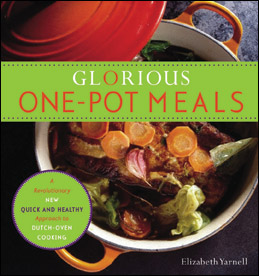
Glorious One-Pot Meals stovetop cooking method

Reader question:
I only have gas rings and no oven (but bought your book anyway as I like the idea); do you have any idea if I can use the recipes in a Dutch oven but by using the stove top rather than an oven?
– Kereebler, Dubai, United Arab Emirates

Hi Kereebler!

I’m psyched to learn my book has made it into the desert around the world! And yes, you can still prepare Glorious One-Pot Meals even if you don’t have a built-in oven.

An easy solution is to get a toaster oven that fits your Dutch oven. In the summertime, I plug my toaster oven in on my back porch and prepare my meals outside so as not to heat up my house.

However, one of my readers, Cas from Wyoming, discovered that GOPMs work just as well on the stovetop as in the oven.

This needs a little bit of advance prep to accomplish because you have to ascertain the temp of your stovetop. Start this on a night you do not plan to cook a GOPM.

The first thing to do is set your empty cast iron Dutch oven on  your stovetop burner. Set an oven thermometer inside your empty pot, put the lid on and turn on the burner to medium. Check back in a few minutes to see what the thermometer reads. You may have to adjust the heat up or down for it to reach 450 F. When the heat inside the Dutch oven stabilizes at 450 degrees F, note the number on the dial of your burner, as this will be important.

Be sure to let the pot cool completely and remember that hot cast iron will crack if it comes into contact with cold water. If you are using an enameled cast iron Dutch oven,  you may see some minor scorching on the outside of the pot where it touches the burner. If you can live with this, you’re good to go.

When you are ready to cook, build your recipe in a room-temperature pot as written in the cookbook. You may want to use water instead of broth, if called for, as the fat in the broth may burn to the bottom of the pot. Otherwise, prepare you GOPM as normal. When the pot is full, place it on your burner and turn the dial to the number you noted earlier.

As when oven cooking your GOPMs, resist the urge to lift the lid before you smell the aroma of a fully-cooked meal wafting from the pot. It should take about 45 minutes to cook — the same as if you were oven cooking.

Don’t give up if your first try doesn’t come out perfectly; you may find that you prefer the way some ingredients turn out over others when you cook this way vs. in the oven.

Thanks, Cas, for figuring out this great work-around for those of us who are oven-less!

Although I have tested this stovetop method, and Cas has used it successfully for years in his rural cabin, it has not been extensively tested all over the world like the traditional GOPM oven method has been. Please let me know your results! Happy cooking!

Adjust Glorious One-Pot Meal Recipes for Vegan and Other Special Diets

Glorious One-Pot Meals Reader Question:
For health reasons, I am on a plant-based diet and I avoid oils, refined foods, and salt. I’d be thrilled to find a recipe for the pot that is consistent with my healthy lifestyle. What do you think? I eat veggies, fruits, beans, whole grains in limited amounts, nuts and seeds. I focus on getting as much nutrition per calorie as possible, which means daily intake of dark leafy greens like kale, collards, mustard greens… I use citrus juices and spices to make things tasty without salt. I don’t mind a little oil on the inside of the pot to keep things from sticking, but wouldn’t add any more than that. I think it would be interesting to try using greens for a base instead of grains. I use convenience foods like canned beans and tomatoes, but only if they have no added salt.

– Michelle from Bethesda, MD

Hi Michelle!

That’s great that you are on a plant-based diet – congratulations!

A quick leaf through the Glorious One-Pot Meals cookbook brings up a number of recipes in the vegetarian section that you’d be able to follow pretty much as written (look at Aloo Gobi on p. 164, Curried Veggies on p. 170, and Turkish Eggplant on p. 189 for starters), and of course, every single recipe can be tailored to meet  your (or any other!) dietary requirements.

This is one of my favorite sea salts!
This is one of my favorite types of sea salt!

You can always experience GOPM success when using parboiled brown rice instead of any of the white rices, too. Parboiled brown rice subs in perfectly for any white rice in recipes. It’s always your choice!

In terms of using greens as a base, check out the Fish Florentine recipe on p. 32 for the technique. Of course, you can use this technique with greens in any recipe, whether or not you choose to add fish. Your instinct for this is right on.

Personally, even though I try to use only organic canned goods like tomatoes and beans, I always rinse the beans before using them, to get rid of any extra preservatives left over from canning.

Even though I don’t like the added salt to canned foods, I do like to use a little sea salt on my food. Unlike table salt, sea salt contains 80+ trace minerals and other nutrients, won’t cause bloating or water retention or raise blood pressure. Your body needs some salt to maintain intracellular homeostasis, particularly if you are working out and sweating. It’s the sodium added to processed foods that is the problem, not natural salts.

Once you get the feel for your pot and how this techique works, I predict you’ll be off  and freely layering your greens, veggies, and whole grains for your own delicious and unique meals.  🙂

Happy cooking!

Elizabeth

Treating Feline Renal Failure with Natural Remedies

Our cat has been diagnosed with Feline Chronic Renal Failure (Feline CRF) but so far we’ve managed to halt the disease with just a couple of natural supplements to her food.

BlueKittyIt started when we noticed that Blue, a 13-year old Russian Blue, was peeing all over the house. She had done this once before, almost 5 years ago, after we moved into a new house and she was too frightened to go to the bathroom outside, as she had done her whole life up until then. We set up a litter box but she would only use it some of the time.

That time, after we paid for a battery of tests to find out she was healthy, we found the answer in a helpful booklet by animal behaviorists. (Turned out she did not appreciate the flushable, biodegradable cat litter I had found. As soon as we switched to a different brand, the problem was solved.)

This time switching the kitty litter hadn’t worked. The vet said she had a bladder infection, so we put her on a round of antibiotics (now, there’s a recipe for a fun time!). That settles that, we thought.BlueInStroller

Wrong. She was continuing to pee around the house. It was almost bad enough to make you wish you didn’t own a cat.

She has feline chronic renal failure, the vet said, looking at her blood work. She just can’t hold it long enough to get to the litter box all the time and she’s dehydrated because her kidneys are starting to shut down. She will need subcutaneous fluid injections regularly, he warned, and a low protein diet can help.

She’s old and it will just be downhill from here, he said.

Hhhhmmmmph.

Some friends have shared with me that it was at this point in their cat’s saga that they simply decided to put the cat down. I wasn’t ready to take that step yet, even though I’ve promised the kids can get a dog when the cat dies.

I refused to believe there was nothing more I could do for her — or for us, who were dealing with finding cat pee all over the house.

I got online to do some research. I found the rec for the low protein/low salt/low phosphorus diet to reduce the amount of waste processed by the kidneys, and also a suggestion to increase the wet food to dry food ratio, giving her more moisture with her food. That made sense since dehydration stresses the kidneys, too.

The vet had prescribed Hill’s Prescription Diet k/d for kidney health. At first it gave her diarrhea, but we integrated it into her old food and gradually switched her over completely. She’s happy because she’s getting a lot more wet food than she used to get.

But there had to be something else I could do to help her. What would I do if she were a human? I wanted to support and nourish her systems.

Kitty Probiotics
I found some probiotics for pets at Vitamin Cottage and began opening a capsule onto her food at dinner. She doesn’t seem to mind the powder and eats it right up.

The probiotics help her body recover from the antibiotics and nurture overall health through digestive health. She seems to have an overall sense of wellbeing these days, and a spring in her step.

Cranberry for Urinary Tract Health
Even more than probiotics, though, I wanted to help support her kidneys and bladder. Cranberries are great for solving chronic bladder and urinary tract infections, and help keep the kidenys clean, I thought, but how do you get cranberries into a cat?

That’s when I found the CatBerry cranberry treats for kitties. She gets two at snack time at mid-morning every day.

If she acts fussy, she’ll get a regular kitty treat alongside the cranberry, and that usually gets her to eat them both.

The result?

The kitty is back to using her litterbox and we are all happier for it.

Hooray! I feel like trumpeting it from the rooftops!

Got Some Magnesium with Your Calcium?

I loved reading Dr. Christiane Northrup’s post on the importance of getting enough magnesium in your body.

She points out that while most doctors recommend women get more calcium in their body to keep their bones strong, they neglect to mention that without magnesium the calcium won’t be absorbed.

A magnesium deficiency might look like constipation, infertility, migraines, muscle cramps, or a whole host of other signs and symptoms.

Carolyn Dean, M.D., N.D., author of The Magnesium Miracle (Ballantine Books, 2007), reports that these (and other) conditions are also associated with magnesium deficiency: blood clots, bowel disease, cystitis, depression, detoxification, diabetes, fatigue, hypoglycemia, insomnia, kidney disease, kidney stones, musculoskeletal conditions, osteoporosis, Raynaud’s syndrome, and even tooth decay. Dr. Dean also reports that she’s seen magnesium improve patients’ PMS, painful periods, chronic fatigue, and fibromyalgia. She’s also seen it increase their sexual pleasure!

My favorite ways to supplement magnesium include snacking on nuts and adding Epsom Salts to the bathtub to absorb it through the skin.