Elizabeth Yarnell Amazon icon Audible icon Autographed icon Bluesky icon Book Bub icon Buffer icon Booksprout icon Buy Me a Coffee icon URL Copied! Copy URL Email icon Facebook icon Goodreads icon Headphones icon Home icon Instagram icon LinkedIn icon Linktree icon Mastodon icon Patreon icon Periscope icon Pinterest icon Reddit icon RSS icon Search icon Share icon Snapchat icon Threads icon TikTok icon Tumblr icon Twitter icon Vine icon Youtube icon Join a free Q/A Call!

What is a GMO?

Today I’m in California to speak about health and nutrition at a symposium on neuromyelitis optica (NMO) hosted by the Guthy-Jackson Foundation. NMO is a rare disease that is often mis-diagnosed as MS, and as always, my emphasis is on eating real, clean whole foods rather than processed, polluted, or otherwise modified foods. What has really surprised me here in California is how many are still clueless about what a GMO actually is and why we might want labeling so that we can have the freedom to choose to eat them or not.

Genetic modification of foods today is not the cross-polination of seeds as initiated by Gregor Mendel back in the 1300s. Of course, modern agriculture continues to breed and hybridize crops to bring out desired traits through natural cross-polination of strains of the same plant, like Gregor’s peas.

Gregor could never have predicted the kind of genetic tinkering going on on our food supply today.

The kind of genetic modifications going on today by chemical giants like Monsanto involve splicing DNA strands from insects and inserting this DNA into food crops like corn and soybeans to make them more resistant to pests in the fields. GMO corn, for example, is designed to explode the stomachs of bugs when they eat it.

Monsanto designs this corn to additionally be resistant to their “Round-Up” herbicide, so that spraying Round-Up will kill any weeds but not the corn plant.

It’s a profitable business model for Monsanto as they own the patents for the GMO seeds and the special weed-killer that goes with it. The GMO corn that grows from these seeds is itself non-propegating (sterile), so the farmer can’t save seeds to grow next season but will have to purchase new GMO seeds again and again.

Forget the profit motive for a moment and lets look at the effect on humans and other mammals who eat this modified corn.

In 1996, when the FDA approved GMOs for planting in the US, the only research on safety in humans presented was from Monsanto’s own scientists. Twenty years later independent research is showing that GMOs cause tumors and infertility in rodents. Animals raised industrially for food – cattle, pigs, chickens – and fed GMO grains are sicker and requiring more antibiotics than ever before.

It seems that while we know how to turn ON a gene on a DNA strand, we don’t know how to turn it OFF after the plant is done growing and harvested for food. When we eat that GMO plant, or eat the flesh, milk, or eggs from an animal that ate GMOs, we bring that activated insect DNA into our bodies. Designed to explode the stomachs of bugs, it can have the same effect on the cells in our stomachs.

The last 20 years have seen an alarming rise in autoimmune disorders, heart conditions, GERD/acid reflux, obesity, diabetes and other issues related to impaired digestion and “leaky guts”.

Even if you choose to ignore the science showing that GMO crops are harmful to humans, animals, and the environment, the key concept here is choice. Right now, we don’t have a choice in whether or not we want to eat genetically modified foods because they are not required to be labeled as such. With 88% of corn and 94% of soybeans in the US now GMO corn and GMO soy, you must assume every corn or soy food you come across is genetically modified and also every packaged food that contains a corn- or soy-based additive like high fructose corn syrup or soy lethicin contains concentrated GMO DNA.

You don’t need to wait for “more research” to opt out of this massive experiment on the public health. Look for the Non-GMO Project seal on packaged goods. Buy organic products and vote for the organic industry with your dollars.  If you are in California, vote YES on Prop 37, as a first step toward nationwide GMO labeling requirements. When the chemical company-funded television ads say that Prop 37 is “unbalanced” because it only calls for labeling “certain foods,” you can understand that those “certain foods” are GMOs; if the food is not GMO, it does not have to be labeled as such!

Besides, if GMOs are so great and great for us, why don’t they want to shout it out that these are “GMO products” and use that in their marketing strategies?

Cooking with Pomegranate Seeds: Orange Roughy with Pomegranate Seeds and Macadamia Nuts Recipe

Every fall I’m excited to see pomegranates in the grocery stores for this short window of time. I fell in love with pomegranates while living in Florence, Italy, in 1989, although I don’t remember the exact first time I tried some seeds. In the years since, I’ve been happy to see pomegranate come up as a Superfood, brimming with vitamins and antioxidents and hailed as helpful in the fights against heart disease and cancers.

I like to drink pomegranate juice and cook with pomegranate molasses, too, but if you can get past the seeding chore, raw pomegranate seeds add a  delightful sweet-tart perkiness when sprinkled into salads, particularly when served with nuts and a soft chevre goat cheese or brie. Cooking with pomegranate seeds adds a whole ‘nother dimension to pomegranates.

Here’s a fun recipe for cooking with pomegranate seeds that I originally debuted in my newsletter:

cooking with pomegranate seeds recipe

[print-me target=”.recipe”]

Orange Roughy with Pomegranate Seeds and Macadamia Nuts

Recent studies have shown that eating macadamia nuts can help lower cholesterol, and the good fats fill you up and keep you satiated. But I eat them because I love the decadent flavor!

Pomegranate seeds give a tartness that offsets the earthiness of the green chiles. The unexpected buttery richness of the macadamia nuts adds another layer of flavor, and their addictive crunch contrasts with the sweet and smooth bananas. Though the chard was a little brown and soggy-looking, it was delicious tasting. Probably Brussels sprouts would have held up better. Good substitutions for macadamia nuts might be pistachios or hazelnuts, and potatoes or plantains for the bananas.

1 Tbsp. coconut oil or other oil
1/2-3/4 lb. orange roughy or other fish fillets
1/2 cup macadamia nuts
1 8 oz. can roasted and diced green chiles, or use a fresh chile
seeds from 3/4 pomegranate
2 bananas, sliced on the bias
Swiss chard, de-spined, chopped roughly
1 medium zucchini, halved lengthwise, then sliced
sea salt and ground black pepper

– Preheat the oven to 450° F.
– Wipe the inside of a 2-quart cast iron Dutch oven and lid with coconut oil, reserving about 1/4 tsp.
– Place the fish filets in the pot.
– Close the Macadamia nuts into a ziptop baggie after squeezing out the air and smash the nuts with something heavy (a Dutch oven? a rolling pin?) until the nuts are in smaller pieces. Pour nuts into a small bowl and add the green chiles and pomegranate seeds. Mix together gently and spread half over the fish with the rest of the coconut oil.
– Layer the banana and zucchini slices on top of and around the fish. Spoon the rest of the nut and seed mixture over all. Top with the chard, filling the pot until it is full. Lightly season with salt and pepper.
– Cover and bake for about 45 minutes, or until 3 minutes after the aroma wafts from the oven. Serve immediately.

Drought Drives Up Food Costs; How to Stretch Your Food Budget

As my friend Nonna Joann Bruso predicted, we are seeing rising food prices as the effects of this summer’s drought conditions sink into the food supply chain.

Restaurants are responding by shrinking portions or raising prices, but the home cook needs to get creative to stretch the food budget. Here are some tips for making your food dollars go further.

Cook at home.quick easy healthy Dutch oven recipes

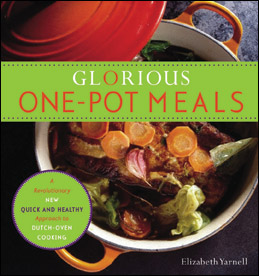
A great way to combat rising restaurant prices is to cook at home more often. Here, of course, I have to do a shameless plug for my Glorious One-Pot Meals cookbook because it introduces a quick and easy technique that makes cooking at home convenient, healthy, and delicious. Check out some video cooking demonstrations to see just how simple cooking this way can be.

Eat vegetarian more often.

Let’s face it, the most expensive part of a home-cooked meal is usually the animal protein. There is already a movement to have “Meatless Mondays,” but you can easily choose to go meatless three or four days a week to cut costs. Who knows, you might even see some other side effects like increased energy and weight loss. Here’s a delicious meatless recipe to try: Farmhouse Pasta!

Stock your freezer.

By loading your freezer up with fresh vegetables while they are cheap and in-season, you can enjoy vegetables all winter long without paying higher prices. Did you miss the harvest window for preparing and freezing your own veggies? Commercially-prepared frozen vegetables may often be less expensive than fresh veggies in the winter. Just make sure that your frozen veggies don’t have any additional additives, and you’re good to go.

Joann Bruso has been devoting a lot of blog space to making your grocery dollars go further, and I suggest you check out her Baby Bites blog for more great tips, suggestions, and recipes for making it through this coming winter of high food prices.

Do you have any tips to share for stretching your food dollars and still eating well and healthfully? Share them in the Comments below!

Natural Remedy for Diarrhea

One of my naturopathic clients complained of a sudden bout of diarrhea that was making her very uncomfortable. When these kinds of occasional bouts of intestinal distress arise, I reach for the healing powers of coconut water and probiotics to help the gut calm down.

coconut water as diarrhea remedyTropical islanders have long known coconut water to be helpful in clearing a bit of dysentery from the occasional spoiled food or a food- or water-borne bacteria that your body wants to expel quickly and forcefully. Diarrhea is one way the body evacuates irritants, so it is important not to artificially stop the flow. Staying hydrated, keeping electrolytes balanced, and eating foods that are easy to digest will keep you more comfortable while your body does what it needs to do to keep you healthy.

Besides offering hydration and bio-absorbable electrolytes, coconut water contains other amino acids and nutrients that help to finish the expulsion and calm the gut. It’s like a special sauce that you’ll only get from the water inside a coconut. You used to have to visit a tropical local and whack off the top of the coconut with a machete in order to drink the sweet coconut water through a straw, but now you can find coconut water boxed or bottled in many grocery stores. I like the individual-serving-sized boxes because they are convenient to keep in the pantry for quick re-hydration after sweaty soccer games. For electrolyte replacement needs, coconut water beats the artificial colors and high sugar content of commercial sports drinks hands down.

Besides coconut water, I recommended that my client start on a probiotic and follow the B.R.A.T diet until she felt better.

The B.R.A.T. diet was designed of non-laxative solid foods to help recover from diarrhea, and it is a regimen my family has turned to many times during the periods of digestive distress due to colds or flu’s as well. B.R.A.T. stands for Bananas, Rice, Applesauce, and Toast. You can modify this as needed, such as gluten-free toast or brown rice, but do not add in apple juice, as it will only encourage the diarrhea to continue. I can always tell when the patient is recovering because they can’t stand to stay on the BRAT diet any longer!

While these tips may be helpful for easing the strain of chronic diarrhea, if your diarrhea is more than occasional it likely means something else is going on such as parasites and/or food sensitivities. Unfortunately, coconut water will not cure either of these conditions, but you are always welcome to contact me to look into other options for getting well.

The Non-GMO Project and GMO Labeling

The Environmental Working Group estimates that the average American now consumes more than his or her own body weight in Genetically Modified foods (GMOs) – 193 lbs. – every year. Since the EWG only took into account corn, soybean oil, and sugar beet consumption and there are many other GMO crops infiltrating our food supply, this is probably a low-ball estimate of how much exposure to GMOs we are actually getting as unwitting subjects in this massive biochemical experiment on the public health.the non gmo project

Because GMOs are not required to be labeled, much of the food you are eating regularly likely contains GMO ingredients like high fructose corn syrup or corn in any form. Since more than 88% of our corn is now GMO corn, we have to assume that most corn-based foods and additives are GMOs unless otherwise labeled.

Not only are GMO foods messing with our bodies and those of our future descendents, but they are wreaking havoc on the environment. According to the EWG’s report on GMOs: “The evidence of environmental harm of GE crops and associated pesticides is compelling. The planting of GE crops has increased overall pesticide use by more than 300 million pounds and has led to the proliferation of pesticide-resistant superweeds and superbugs.”

Right now, the Non-GMO Project is the only way short of organic that you can be sure that the food you are eating is not a genetically modified chemistry experiment with long-term effects on your body. The Non-GMO Project is a non-profit that offers the only third-party verification seal on products not using GMOs. Look for their seal on products at the grocery store to be sure you are keeping your family safe.

If you need any other reasons why it’s important to label GMO foods, watch “Genetic Roulette,” a compelling documentary about GMOs in America. Right now, GMO labeling is on the ballot in California, so if you live in California be sure to vote YES on Prop 37 and help labeling laws spread across the land to allow each of us to protect ourselves and opt out of the experiment.