Elizabeth Yarnell Amazon icon Audible icon Autographed icon Bluesky icon Book Bub icon Buffer icon Booksprout icon Buy Me a Coffee icon URL Copied! Copy URL Email icon Facebook icon Goodreads icon Headphones icon Home icon Instagram icon LinkedIn icon Linktree icon Mastodon icon Patreon icon Periscope icon Pinterest icon Reddit icon RSS icon Search icon Share icon Snapchat icon Threads icon TikTok icon Tumblr icon Twitter icon Vine icon Youtube icon Join a free Q/A Call!

Probiotics Before and After Birth Can Decrease Later Allergies

Eczema Hands
Eczema (skin irritation) on my daughter’s hands when she was 5 years old.

Supplementing babies and pregnant mothers with probiotics was shown to decrease eczema by 77%, according to a  July 2014 study published in the official journal of the Japanese Society of Allergology (JSA).

After supplementing 130 pairs of mothers and newborns with probiotics in the final trimester of pregnancy and post-partum, the researchers concluded, “These data suggest that the prenatal and postnatal supplementation of bifidobacteria is effective in primary preventing [sic] allergic diseases.” There were 36 pairs in the control group who did not get supplemented.

The National Institutes of Health estimates that up to one-third of us have some sort of skin condition stemming from an allergic or hypersensitivity reaction, and it usually begins in infancy or childhood. According to the Asthma and Allergy Foundation of America, one in five Americans (50 million people) suffer from allergies, and allergies have been increasing in prevalence since the 1980s.

It makes me wonder: if allergies and hypersensitivities can arise from a lack of good bacteria in the digestive tract at birth, and there has been an increase in the prevalence of allergies, what has changed in our dietary patterns and food supply that is making us deficient in good bacteria?

This was the topic of my TED talk that I presented at TEDx Colorado Springs this past weekend. While I didn’t talk about this particular study, I did discuss how our food supply is riddled with hidden toxins that can cause us to become inflamed, and how inflammation leads to disease symptoms. (I’ll post the link to the talk when it is available!)

I also wonder if there is there any correlation between babies born by c-section and later issues with digestion and allergies, but the summary of this study did not include this information.

New web site, new credential, upcoming TED Talk, and more…

So much has been going on in my life and career lately that I am overdue with updating my readers and followers with exciting news and upcoming events.TEDx CS

This coming weekend I’m honored to be giving a TED talk at TEDx Colorado Springs. TED is a non-profit devoted to sharing ideas through short, powerful talks by expert speakers. TEDx talks are TED events at a local level. The title of my talk is “We Are What We Eat: Poisons In Our Everyday Foods.” You can see the TEDx Colorado Springs event schedule here, and, while it will be live-streamed and available online for posterity, I believe there are even a few tickets still available to attend in person. I will be sure to post the link to my talk when it is up.

ANMAlogo2
I’m proud to announce that I have passed the board exams and am now a
Board Certified Naturopathic Doctor! It is incredibly gratifying and validating to have achieved this level of credential in my profession and be able to provide my patients around the country with certified confidence in my abilities to help them feel better.

ey_com_masthead

Another exciting event has been the overhaul of my website at www.ElizabethYarnell.com. Not only has the entire layout changed (and become mobile-friendly!), but I’ve been working on consolidating many of my other sites and endeavors onto this single domain. The internet has changed so much since I first launched this site in the early 1990s, and the most recent design dated to 2008, so it was a big and long-overdue process.

LIZ-EE-Logo-Background-KeylineHave you noticed that my blog, “Effortless Eating,” now also resides on www.ElizabethYarnell.com instead of on its own URL as before?

Additionally, the Fight MS with Food project has taken up residence on this site, and GloriousOnePotMeals.com is gradually moving over as well.

This new design and platform makes it easier for me to add and change content and for you to navigate and find pages that used to be buried in secret places. Please feel free to poke around and explore!

Finally, I added a page for my clients to leave testimonials about working with me. If I helped you feel better, I would be honored if you would pop over and leave a Comment sharing your original diagnosis or symptoms and how you feel now. Testimonials are a resource for helping others who are suffering make the decision to find help for their issues.

It has been a busy time around here! Thanks for sticking with me as my knowledge and business continues to grow and evolve.

Cooking with Yogurt in Glorious One-Pot Meals

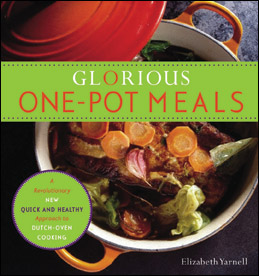
Reader question: Good evening,  First, I found the one pot meal book yesterday and made my first one today. I was very impressed. I altered one of the recipes and made a mandarin orange chicken thing (fiddling with recipes and directions is sort of a hobby of mine) and it came out very beautifully. I was a little nervous–I am blind and they do not make a fully accessible talking oven thermometer and I therefore can’t get oven temperatures completely right–but it all went well.  I do have a question. One of my favorite cuisines is Indian (from India) and that cuisine uses a lot of yogurt. Sometimes when you cook with yogurt it can curdle. Is that a risk with this infusion technique?  And lastly, are there any sort of rule of thumb when adapting a stovetop recipe to a onepot meal recipe?  Thanks for the cookbook and the great ideas.  ~Rob  H., St. Cloud, MNGlorious One-Pot Meals

Hi Rob. I know Glorious One-Pot Meals is available as a book for the blind and I love hearing from my blind readers who have taken this technique and run with it!

To answer your question about yogurt: I have prepared Indian cuisine in a GOPM using yogurt and have not noticed any curdling. (Check out the Shrimp Masala with Rice recipe on page 78 in the cookbook!)

Perhaps the yogurt doesn’t curdle because the ingredients all cook toward the end when the temperature inside the pot is hot enough and the yogurt doesn’t spend a lot of time lukewarm? Perhaps because the cooking time is so short there is not time for curdling? It’s a mystery but it works.

As for adapting stovetop recipes for using in the Glorious One-Pot Meal technique, I don’t know if I have any “rules of thumb” other than to follow the basic formula that all GOPM recipes use with the same ingredient proportions. Once you have made a few GOPMs, you’ll notice that any combination of ingredients can be used following the same steps.

I hope this answered your questions! Thanks for writing and happy cooking!

Gluten-free Organic Red Lentil Pasta

I saw a new product at the natural health grocery store the other day and couldn’t wait to try it: Tolerant Foods’ Organic Red Lentil Rotini.gluten free pasta

Since Non-GMO organic red lentils are the sole ingredient, this pasta is grain-free as well as wheat-free.

Last night I cooked the pasta in boiling water for 8-10 minutes, then drained and served topped with marinara sauce and sautéed zucchini rounds and garbanzo beans. The pasta was deliciously al dente, held its shape well, and was accepted easily by my kids and even my husband, who has been known to turn up his nose at pure rice pasta.

If you’re good with lentils, you should give it a try. It will definitely become a staple at our house.

Wheat-free Banana Spelt Muffins

Many people may think they are sensitive to all gluten when in fact it is the wheat itself that causes them problems.

In America, our wheat crop is the most highly pesticided crop there is, and our wheat products are full of pesticide residue. Add to this the fact that today’s wheat strains are the result of so much hybridization and cross-breeding that the gluten protein does no longer resembles a gluten protein even from the last century. This makes it hard to determine just where the symptom-inducing sensitivity might lie.

I have found that people who are sensitive to wheat products often do just fine with spelt, an ancient cousin of wheat that has recently been rediscovered.

Like wheat, spelt is also in the gluten grain family but since it has not been as popular it has not been tinkered with the way wheat has. Spelt flour is a great one-to-one alternative for all-purpose wheat flour when baking, which is why I reached for it when I wanted to use up some bananas that had passed their prime.

These simple Banana Spelt Muffins are a delicious alternative to wheat-based muffins, and the recipe is eminently flexible to allow for almost any dietary restrictions. Enjoy!

Banana Spelt Muffins

Banana Spelt Muffins

Makes 12 muffins.

  • 2 overripe bananas, smashed well
  • 2 eggs or egg substitutes
  • ¼ cup melted organic butter or other oil
  • ½ cup organic sugar or other sweetener (honey, agave, maple syrup, etc.). Can add more, if you like sweeter muffins.
  • 1 tsp. pure vanilla
  • 1 ½ cup spelt flour, coconut flour, or gluten-free flour mix of rice, tapioca, and potato flour
  • 1 tsp. aluminum-free baking soda
  • ¼ tsp sea salt
  • 1 cup shelled walnuts, other nuts, chocolate chips, shredded coconut, etc. (optional)

Preheat oven to 350 F. Place muffin liners in a cupcake tin, or grease well if not using liners.

In a medium bowl, puree bananas. Add melted butter, sugar, and vanilla, and mix well with a fork.

In a large bowl, blend together flour, baking soda, and sea salt. Add bowl of bananas to the flour mixture and stir together until well-blended. Fold in walnuts, if using.

Scoop into muffin tins, filling each cup about half full. Place in oven and bake for 35 minutes, or until an inserted toothpick comes out cleanly.