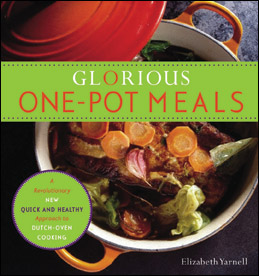
Reader Question: Would canned salmon be a good substitute for Glorious One Pot recipes? ~ John R., Austin, TX
Hi John! I’m thrilled that you have been enjoying Glorious One-Pot Meals! While I have never tried using tinned salmon in a GOPM, I have used canned tuna and it worked perfectly, so I would assume that canned salmon would work just fine as well. Tinned fish is a great option for adding to GOPMs – thank you for bringing it up!
It’s hard to believe that 2019 is the 10th anniversary of Glorious One-Pot Meals! I’ll be celebrating all year, so stay in touch to celebrate with me.
Reader comment: I have Lewy body dementia. I’m 100% soy free. And completely 100% symptoms free of dementia. As long as I have no soy or soy lecithin in my system. ~ John B., Rosenberg, TX
Hi John! Thanks for sharing your experience! I definitely agree that food sensitivities and the inflammation they cause can influence mental awareness and I’m glad to hear you have identified your trigger with soy and are able to live symptom-free simply by avoiding soy and soy lecithin.
It can be difficult to identify the culprits that are creating symptoms such as dementia, which can lead people (and doctors!) to believe that there is no way for sufferers to avoid losing their minds. However, as your testimonial shows, there is a path to avoiding dementia. As you have discovered, the key is to identify your personal inflammatory triggers and avoid them, just like Celiac patients live symptom-free if they avoid exposure to gluten.
You are fortunate to have identified your triggers without help, however if you start experiencing symptoms even when abstaining from soy, then the MRT food sensitivity test could help you figure out additional sensitivities.
Congratulations on “reversing” this disease course by identifying your inflammatory trigger and I wish you a long and healthy life!
If you are suffering from a disease that is robbing you of your mind like dementia, Parkinson’s, or Alzheimer’s, it would be worth having a conversation with me or my team to determine if a customized anti-inflammatory diet could help you recover your life like John did. Contact me by email to schedule a free initial phone consultation and get started on living –and remembering!– the rest of your life!
Hell yes! YES, what we eat directly affects how our gut reacts and how our bowels perform. How could it not?
Human digestive system
It always blows my mind that doctors ignore diet when treating issues of the stomach and bowels, but that is the current medical standard of care. There is a direct anatomical path from the mouth through the esophagus to the stomach, and then through the intestines to the colon and exiting out through the anus. How could we not recognize that the foods we select to send down that path could be the culprits when it comes to issues along that route such as bloating or gas, cramping or acid reflux, diarrhea or constipation?
Why is this? Maybe because the concepts of nutrition and diet aren’t covered extensively –or often, not at all– in medical schools, not even for gastro-intestinal specialists. Allopathic doctors are taught to be suspicious of all ideas about health and healthcare that were not presented in medical school or published after large, “Phase 3” placebo-controlled clinical trials, and these are not the best ways to study dietary or nutritional interventions in individuals. Even long-term population-based data on diets can be be misleading because of the impossibility of separating out a single ingredient and correlating it to a health outcome by ignoring the rest of a person’s or population’s food intake. The fields of diet and nutrition have been relegated to the “less-than-doctor” status of Nutritionist or Dietician or even Coach, leading doctors to give food even less credibility when it comes to health.
Or maybe doctors don’t talk to patients about dietary factors because they simply don’t believe in health solutions without pharmaceutical aids. Immunosuppression, or shutting down the immune system’s natural reactions through steroids or other chemical means, is a key medical strategy for addressing gut health issues. It’s tragic because, while steroids can decrease the inflammation and the associated pain, they do not address the root of the problem to begin with.
Even more tragic is the other popular medical solution to continued pain and discomfort along the digestive tract: cut it out. Gallbladders, intestines, colon… you have the right to fight to keep your body intact and functioning! Every part of our body has a function, and once it’s gone, that loss will affect you for the rest of your life. It makes me want to shout from the rooftops: “Before you let someone remove part of your body unnecessarily in order to deal with gut issues, reach out to me and let’s talk about your diet first!”
Dr. Johnson hopes medical officials will start recognizing that “…we have biologic evidence that this makes a difference. It is time for us to start taking a good diet history and treat patients with IBD appropriately. Start looking at diet; it has a key role in the pathogenesis of IBD and may offer a tremendous opportunity in its treatment.”
Dr. Johnson is off to a good start by suggesting that patients with gut dysfunction should begin by eliminating artificial additives and preservatives. He lists carboxymethyl cellulose, polysorbate-80, maltodextrin, and carrageenan as ones to avoid. As I mention in my TEDx talk, these synthetic ingredients are pervasive in our food supply, and avoiding them is easy to do by simply reading labels and learning where they show up most often. I would add food dyes and colors, artificial fragrances, and all artificial sweeteners to this list, along with other chemicals.
Where Dr. Johnson and most other well-meaning doctors fall short is in understanding the best diet to recommend for an individual patient. While he notes that the Mediterranean Diet is preferable to the Standard American Diet, he doesn’t understand that the optimum diet is unique for each individual. This is crucial to understand whether someone is dealing with debilitating gut or bowel function as with Crone’s Disease, or with run-of-the-mill acid reflux or IBS. From my decade of experience designing customized anti-inflammatory diets through my nationwide food sensitivity clinic, I believe the best way to do this is by using the Mediator Release Test (MRT) followed by LEAP Dietary Therapy.
Doctors are uniformly skeptical of this approach (due to the reasons listed above), but I tell them the same thing I tell all of my clients: “You have to eat anyway, so you might as well choose the foods that are not inflammatory for you. What have you got to lose?”
What have you got to lose? In just two weeks you could be feeling markedly better and on the road toward better health, simply by adjusting your food choices.
Contact me for a free initial phone consultation to see if a customized anti-inflammatory diet could help you feel better and live a better life!
Reader question: Are the calories listed below each recipe the total calories of meal for two people? Amazed by low calorie count! ~Mary W, Grayslake, IL
Hi Mary! You’re right that those calorie counts listed for Glorious One-Pot Meals would seem awfully low if they applied for the entire meal! Usually calories are listed per serving on product boxes and in recipes, and it is the same for Glorious One-Pot Meals recipes. Each recipe represents two servings, but the calorie counts are per serving.
But I’ll confess that I’m not a big fan of this kind of nutritional counting for many reasons and I really resisted including the counts in my cookbook (I lost that fight, obviously). Not only do I believe that a whole-foods-based diet is healthier than a low-calorie diet, but I think that the whole “calories-in-vs-calories-out” philosophy of dieting is a flawed theory of weight loss.
Additionally, if you do any substituting in the Glorious One-Pot Meal recipe from what is written, as I encourage the reader to do on almost every page of the cookbook, then those calorie counts will change anyway.
While I have received many testimonials from readers enthusing about how eating GOPMs have led to weight loss simply because they are eating more whole foods and veggies, the best way to identify the foods that are inflammatory for each of us is to identify our sensitivities by taking the Mediator Release Test (MRT). It’s truly the gold standard in determining which foods and chemicals/additives in our foods are inflammatory for your unique body. If weight loss is your goal, the MRT and LEAP dietary therapy can help you make the least inflammatory GOPMs for yourself.
Sometimes the MRT results can be really surprising. For myself, I learned that lettuce causes inflammation in my body. Lettuce! How ridiculous is that?! But I can clearly tell that eating lettuce causes me to inflate a dress size overnight. If I eat some avocado with that lettuce, that’s two dress sizes up. Its crazy! However, once I stop eating my inflammatory foods the inflammation will recede, regardless if I am reducing calories or not.
It’s a new paradigm in weight loss.
I’m happy to offer my readers a free initial phone consultation if they’d like to know more about food sensitivity testing, the MRT and LEAP. Just fill out this form to get started losing weight – without counting calories!
When was the last time your meal was vegetarian, i.e., didn’t include any meat? If it has been a while, you may want to make it a point this month to eat a few meatless meals. And not just because it’s National Vegetarian Month.
In fact, there are lots of great reasons to abstain from eating meat at least now and then. Not only has a plant-based diet been found to be health-giving and leading to a longer life, but there’s an additional environmental benefit when we don’t contribute to the huge industrial machine that raises most of the animals Americans eat as food.
The best part is that you don’t have to completely abandon meat to appreciate these positive effects; simply focusing more on vegetables than meat in your daily life can make a difference in how you feel every day.