Elizabeth Yarnell Amazon icon Audible icon Autographed icon Bluesky icon Book Bub icon Buffer icon Booksprout icon Buy Me a Coffee icon URL Copied! Copy URL Email icon Facebook icon Goodreads icon Headphones icon Home icon Instagram icon LinkedIn icon Linktree icon Mastodon icon Patreon icon Periscope icon Pinterest icon Reddit icon RSS icon Search icon Share icon Snapchat icon Threads icon TikTok icon Tumblr icon Twitter icon Vine icon Youtube icon Join a free Q/A Call!

How to Decrease Asthma, Allergies

A reporter recently asked me for the top five foods I recommended avoiding feeding to young children to boost their chances of growing up allergy-free.

I found this to be an impossible task.

From all that I’ve learned in my studies over the last decade, I believe that each person’s hypersensitivity profile is unique to themselves. What might cause problems for Joey might be fine for Susie, and vice versa.

Although certain food groups may seem to commonly cause adverse reactions –like dairy, gluten, or soy – it’s too easy to unnecessarily restrict your child’s diet and miss basic nutrients by making random guesses at what allergens are already causing or might someday cause distressing issues in the general population.

After all, most people (70-90%)have normal tolerance thresholds and never or rarely experience abnormal reactions from foods. Only about 7% of the population actually has Celiac Disease and reacts to gluten, for example.

So you see how it might be difficult to make a blanket statement to recommend that everyone avoid all the same foods with the goal of decreasing everyone’s potential for developing allergies.

Lowering Your Overall Toxic Load Will Increase Tolerance

That said, I do believe that by eliminating as many chemical items and known poisons from your child’s overall toxic load as possible you’ll help his/her body develop higher tolerances and experience fewer allergic reactions from anything.

These are the items I would suggest eliminating (or at least minimizing) from a child’s diet in order to lower his/her potential for asthma, allergies, and other aberrant immune reactions:

1. Food Dyes. A recent compilation of studies found a correlation between ADHD and commercial food dyes used in many familiar products. These dyes are in almost every food item marketed to children, and in many other commonly eaten products.

I can see this happen in my own son as his behavior will deteriorate rapidly after eating something artificially colored. The food dyes cause hypersensitivity reactions in him that result in a mediator (i.e. histimine, et al.) release. This is often called an allergic reaction, though the correct term is a “hypersensitivity reaction.” The mediators/histamines/cytokines cause swelling in the brain that manifests in behavioral changes and mental distraction. Removing food dyes can eliminate the need for Ritalin or other behavior-modification drugs.

2. Synthetic Sugars. From Splenda to Aspartame, Sucralose, Fructose, and High Fructose Corn Syrup, these all work to confuse the pancreas and create an off-balance internal environment. They’ve also been shown to contribute to weight gain, not weight loss. Give children real raw cane sugar, pure maple syrup, or honey when possible and avoid all artificial sweeteners.

3. “Natural Flavors”. The term on a label of “natural flavors” may translate to a chemical brew of more than 40 noxious components. See here for a list of the “natural flavors” in one strawberry milkshake. The ingredients in “natural flavors” are considered top secret and not public information.

4. Artificial and “Natural” Fragrances. Again, I’m referring to the labeled term “natural aromas or fragrances” used in many cosmetics, personal care items, soda pops, markers, and other products.

Aromas are physical molecules that travel into our bodies when we inhale. Breathe in deeply to fully appreciate the fresh scent offered by that dryer sheet or air freshener spray, and you’re bringing those synthetic, laboratory-constructed molecules down deep into your lung tissues where they can get trapped and come back to haunt you later.

Many artificial scents and flavors are made from petrochemical derivatives. Artificial fragrances contribute heavily to one’s toxic load, and for asthmatics and other hypersensitive people they can trigger an immune response.

5. Petroleum Products. Our modern society is saturated with petrochemicals that are in every plastic item we touch, almost every water bottle we drink from, and every canned food we eat. Our cosmetics are full of petroleum, as are our skin care lotions, suntan lotions, and perfumes. Our skin is our largest organ, and it did not evolve to handle being smothered by a toxic sludge found far below the surface of the earth.

Everyone’s tolerance threshold for toxins and allergens is different.

Once a person breaches their tolerance threshold and enters toxin overload, you might see a cascade effect where more and more substances cause more and more reactions. These issues may manifest as asthma, IBS, migraines, exzema, fibromyalgia, hives,… and on and on. We’re now learning that many auto-immune responses, perhaps even multiple sclerosis, may be due to hypersensitivity reactions.

Alessio Fasano, professor of pediatrics, medicine and physiology and director of the Mucosal Biology Research Center and the Center for Celiac Research at the University of Maryland School of Medicine, wrote in Scientific American’s August, 2009, issue that,

“Indeed, a growing body of evidence suggests that virtually the same trio of factors underpins most, and perhaps all, autoimmune diseases: an environmental substance that is presented to the body, a genetically based tendency of the immune system to overreact to the substance, and an unusually permeable gut.”

Get rid of the chemicals as a start down the right path for avoiding allergies.

While it may be impossible to say what foods everyone should avoid to decrease their risk of developing allergies, it’s much easier for me to say which chemicals and synthetic substances we should avoid to avoid crossing all of our tolerance thresholds, not just in kids.

Quick and Easy Gluten-free Dinner from Leftovers

Last weekend we grilled wild-caught Alaskan salmon on a cedar plank alongside some asparagus rubbed with olive oil. As scrumptious as it all was, we still had some leftover the next day for me to incorporate into another dinner. I decided to incorporate the leftovers into a pasta salad and make it all new again.

I boiled some fusilli pasta (we used Tinkyada rice pasta because our house is mostly wheat-free due to my son’s food sensitivities, but you can use any kind of pasta you prefer). When it was al dente tender, I drained and rinsed it with cold water in a colander.

Meanwhile, I had washed and chopped a bunch of fresh spinach that was waiting in a large bowl. Into the bowl, I also added the remainder of the cedar-planked salmon and grilled asparagus, cut into bite-sized pieces. I dumped the still-warm pasta on top and covered it all with a pot lid so that the spinach would wilt a bit.

I shredded some fresh basil leaves from the plant in my garden and chopped up the last few mushrooms left from earlier in the week.

As a crowning ingredient, my daughter suggested we toss in about 1/2 cup of shelled pistacio nuts. Why not, I thought. We dumped the nuts in.

Now it was the moment of truth: what should we flavor our pasta salad with? I like to use a vinaigrette with a pasta salad, but should it be Italian, Pomegranate Chipolte, Roasted Red Pepper, or Shitake-Sesame? Annie’s Natural Shitake- & Sesame Vinaigrette, always a crowd pleaser, won the vote.

I poured it on and tossed it up. The spinach had wilted nicely from the heat of the pasta, and everything married together beautifully. The pistacio nuts turned out to be the surprise favorite – a nice touch of crunch to the salad!

My 7-year old son has decided of late that he doesn’t “like leftovers,” regardless of how eagerly he cleaned the plate of the same food a day or two before. Luckily, a pasta salad can be a great way to incorporate leftovers and not call them “leftovers” anymore! Here’s another fun pasta salad recipe to try!

Glorious One-Pot Meals on KVOR radio

On September 15th, I’ll be heading south to Colorado Springs to offer a program called “Healthy and Easy Cooking to Manage MS.” This weekend, the food editor of the Colorado Springs Gazette, Teresa Farney, interviewed me on KVOR radio about the upcoming talk and cooking demonstration – listen to the 7-minute interview here.

If you are interested in joining us at the event, contact the Colorado Springs, Colorado, office of the National Multiple Sclerosis Society at 1-719-634-298. You can also call 1-800-FIGHT-MS or go to cureMSColorado.org to register.

Due to space limitations, this program is limited to those struggling with MS and those who care for them. Hope to see you there!

Using a Convection Oven for Glorious One-Pot Meals

Reader question: What adjustments should be made for a convection oven? Do I adjust the time or the temperature? My copy of the cookbook should arrive today – I heard you on Martha Stewart Radio. I am looking forward to making wonderful meals this weekend. – Janelle F., Montgomery, Alabama

[ad#Right align in post]Great question, Janelle! To answer it well, we first need to understand how convection ovens work. In a convection oven, several fans circulate the air as it is heated. The effect is to make the baking or roasting of uncovered foods, like cookies, roasts, cakes, etc. happen more quickly. Convection ovens routinely drop the desired temperature by 15 degrees F to compensate for the increased exposure of the food to the heat so that the food doesn’t become overdone.

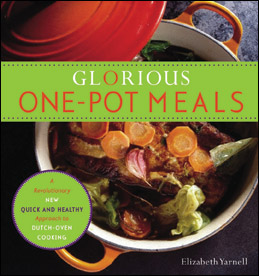
Glorious One-Pot Meals remain lidded the entire time they are in the oven; as such, they do not get any additional benefit from the circulating hot air. Moreover, they do not cook properly at 435° F; For Glorious One-Pot Meal success, your oven must be at 450° F before placing the loaded and covered pot inside.

Many ovens offer the choice between convection and conventional settings. I always choose conventional when possible as it uses less energy. If using a convection oven, however, just be sure to compensate for the automatic temperature drop. Your best bet is to place a stand-alone oven thermometer in the oven to ensure you have the correct temp before inserting your Dutch oven.

Thanks for listening to the interview and happy cooking!

Elizabeth