Elizabeth Yarnell Amazon icon Audible icon Autographed icon Bluesky icon Book Bub icon Buffer icon Booksprout icon Buy Me a Coffee icon URL Copied! Copy URL Email icon Facebook icon Goodreads icon Headphones icon Home icon Instagram icon LinkedIn icon Linktree icon Mastodon icon Patreon icon Periscope icon Pinterest icon Reddit icon RSS icon Search icon Share icon Snapchat icon Threads icon TikTok icon Tumblr icon Twitter icon Vine icon Youtube icon Join a free Q/A Call!

Homemade Mayonnaise

In my world of helping folks with food sensitivities live more comfortable lives, I’m always looking for recipes with the fewest ingredients that might cause problems. So, I was excited to find Katie at Kitchen Stewardship’s quick and easy recipe for homemade mayonnaise that can be made with only  5 ingredients.

Check out her video to see how easy whipping up a batch of mayo can be.

Here is the food-sensitivity-safe, otherwise known in the biz as *”LEAP-friendly“*, recipe for mayonnaise:

2-3 egg yolks
1/2 tsp. mustard powder
1/2-1 Tbs apple cider vinegar or lemon juice
1 tsp. sugar (or any sweetener, optional)
1/2 tsp. salt

Method: Blend everything but the oil with your immersion blender in the tall cylinder that came with it.  Add the oil, pouring slowly while blending constantly.

Katie’s Tips for Success:

  • Bring the eggs to room temperature, at least 2 hours on the counter.
  • Most recipes say 2-4 egg yolks.  I always start with two because I’m cheap!  If the mayo doesn’t firm up, just pour out the mixture, put another egg yolk in your container and pour everything else back in, slowly, as if it’s the oil in the original recipe.  Once I had to do this fix twice, but it worked eventually!

Katie also offers other ideas for add-ins to flavor your mayo, including garlic powder, white wine vinegar, and paprika. You should feel free to add whatever you crave that is safe for you to change-up your mayo.

Please post a comment here if you try this mayo! We’d love to hear your experiences.

* “LEAP-friendly” refers to a recipe that only includes ingredients you know you are not reactive to. In other words, if you know you are sensitive to eggs, this recipe is obviously not ok for you. At the same time, if you haven’t actually been tested, you may never be completely sure what you may be sensitive to and, conversely, what items for sure don’t provoke inflammatory reactions. If you are having trouble identifying the cause of your suffering, you might find relief with MRT food sensitivity testing.

Remedies for nighttime coughing

A naturopathic client has been complaining of coughing fits at night this spring. He says that it is not as bad when he closes the windows and uses the air conditioner, but it is still interfering with his sleep. An ENT used a nasal scope to see small, weak, red bumps and inflamed tonsils but could not identify an infection. The patient asked me for some advice on what to do.

A little deductive reasoning suggests that he might be reacting to some pollen in the air in this season of blooming plants. Many plants and trees bloom at night, releasing their pollen into the dark. To begin with, there are some hygienic steps I recommended he take to limit his exposure and reduce his reactions:

  • Keep windows closed at night and shower before bed to remove any pollen from hair, etc.
  • Try a daily nasal rinse before bed to clean out sinus passages and remove allergens. Here is the one I like: NeilMed SinusRinse.
  • Leave shoes at the door and keep the house a shoe-free zone. The Japanese have it right here: shoes track in all kinds of germs and debris that you don’t want in your living space.
  • Change the filters on the air conditioner and furnace to clean, high-quality filters.
  • Consider using a HEPA-certified air purifier — these can make a real difference in the air quality inside your house, particularly during times of high pollen or other forms of air pollution.

Other remedies he might try include:

  • Eucalyptus essential oil. Pour a few drops in a hot bath or diffuse it with a humidifier at night in the bedroom. Rubbing a few drops directly into the soles of your feet can stop a coughing fit in the midst of it.
  • Homeopathic hayfever remedy. This will not interact with any of the other meds and it only needs to be taken 1-5 times a season to get complete relief from pollen allergies.
  • Probiotics.  Help boost your tolerance threshholds and immunities by keeping your digestive system in good order. More than 80% of our health starts in the gut. Good Belly is a good, all-around probiotic dairy-free juice drink that is very bio-available and contains lots of other good-for-you nutrients as well.
  • Locally-collected bee-pollen. A spoonful or two of these pebble-like secretions from bees can help you resist pollens active in your area. Check the refrigerated section of a good health food store to find bee pollen from your vicinity.

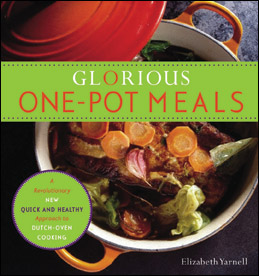
Using chicken in Glorious One-Pot Meals

Reader question:  Can I substitute boneless chicken breast for recipes that call for chicken breasts or thighs? Thanks – Laura,  Martinez, CA

Hi Laura,

Thanks for your question! Of course, you may substitute any protein for any other protein in a Glorious One-Pot Meal, including but certainly not limited to, chicken breasts for chicken thighs. In GOPM cooking, you may choose bone-in and skin-on pieces of chicken as easily as boneless-skinless pieces… it really doesn’t matter. As with any type of cooking, including the bones in the cooking process will add more flavor, and leaving chicken skin on will certainly add more mouth-watering, calorie-laden fat, but it’s completely your choice. With every GOPM recipe, you get to choose exactly what goes in so that you end up with the meal you want by using this quick, easy, and healthy cooking method.

In our house, I like to change things up and sometimes use thighs or legs rather than the boneless-skinless chicken breasts I typically use. My husband prefers dark meat in his poultry, and I’ve noticed that using thighs adds a richness to the sauce you don’t get with breasts. Of course, that’s because of the extra chicken fat you get in thighs, but because we follow a whole-foods based diet that is generally low in saturated fat, this doesn’t bother my overall health aspirations for my family. There’s a reason professional chefs cook with a lot of fat: because it makes food taste good. I would prefer that the fat in my food came from a whole food source like a chicken rather than a processed, artificial source like Crisco.

But I digress from your original question. Yes, boneless chicken breasts cook up wonderfully in Glorious One-Pot Meal recipes. In fact, I keep a supply of individually-frozen, boneless-skinless chicken breasts in my freezer just for making GOPMS. I can toss frozen-solid chicken breasts into my Dutch oven along with other ingredients either fresh, frozen, or canned, and it won’t increase the cooking time of my GOPM by even one minute! Not having to remember to thaw the chicken for dinner is a real convenience in my house!

Please feel free to ask me any other questions as you make your Glorious One-Pot Meals.

Happy cooking!

Elizabeth

ADHD may be affected by diet

Researchers from the University of Copenhagen recently released results of their comprehensive overview of the research covering ADHD and diet. What did they find?

“There is a lot to suggest that by changing their diet, it is possible to improve the condition for some ADHD children,” says the head of the study, professor in paediatric nutrition Kim Fleischer Michaelsen from the Department of Human Nutrition at the Faculty of Life Sciences, University of Copenhagen. “Our conclusion is that more research is required in the area.”

I know from watching my own son react to things in his food that food sensitivities can cause very real mood and social eruptions. Just yesterday, in fact, my son burst into tears and stormed away from the dinner table. When I questioned what he had eaten that day, he confessed there had been a birthday in his third grade classroom and the mother had distributed cupcakes with blue frosting. He felt safe eating his cupcake because it was blue and not red or yellow, the common food dyes (FD&C) that cause him to become violent, anti-social, brooding and dark, and physically aggressive around 7 hours after he ingests them. When this happens, it’s like he is uncomfortable inside his own skin and has a hard time sitting still, focusing, or respecting others. I suspect there must have been some red mixed in with the blue color in the frosting (perhaps it was more toward purple?), which would time perfectly from his 11 am cupcake to our 6 pm dinner meltdown.

It took a long time for us to connect the dots between what he was eating and how he was acting so many hours later, and there were many difficult, hair-tearing-out years before we were able to pinpoint the elements in his diet that were causing the behavior problems.

I would assert that much of the ADHD we see these days could be helped significantly by implementing customized dietary changes. As the Danish researchers noted, “Several of the studies show, for example, that fatty acids from fatty fish moderate the symptoms. Other studies detect no effect. Elimination diets are also promising. These look at whether there is anything in the diet which the children cannot consume without adverse side effects.”

The hard part is the guesswork in figuring out the best treatment plan for your ADHD sufferer. You could follow general dietary guidelines in a one-size-fits-all approach, or use random guesses to determine what foods to eliminate, but if you want a scientific guide based on laboratory analysis, you might consider food sensitivity testing.

I’ll confess that life at my house is much happier for all family members now that my son is not suffering most of the time. Of course, he, too, is significantly happier because he feels better!

What are IgE allergies?

As I’ve discussed previously, food allergies are different from food sensitivities. Food allergies occur when exposure to a food causes your body to create IgE antibodies, which then cause an immediate and often severe reaction to occur at the next exposure.

People with food allergies often experience serious, life-threatening symptoms within minutes to an hour of eating the offending food that may include hives, respiratory distress, and even anaphylactic shock leading quickly to death.

The eight most common IgE food allergies according to the Mayo clinic are:

  • milk
  • eggs
  • peanuts
  • tree nuts (such as almonds, cashew, and walnuts)
  • fish (such as bass, cod, and flounder)
  • shellfish (such as crab, lobster, and shrimp)
  • soy
  • wheat

food allergy for dummies by Dr. Robert WoodEven though IgE testing is the standard food allergy testing procedure, using either a back-scratch test or by examining the blood, it might not tell the whole story. Allergist Dr. Robert Wood, Pediatric Allergist and Professor of Pediatrics at the Johns Hopkins Children’s Center, and author of Food Allergies For Dummies, explains that IgE antibodies may or may not be a reliable indicator of a food allergy, and in fact IgE testing is not entirely accurate as sometimes people will react to a substance and not have any IgE antibodies while other times there will be a large number of IgE antibodies but the person is in fact non-symptomatic to that allergen.

Food sensitivities, on the other hand, are dose-dependent and may be delayed by up to four days after ingestion. They do not create IgE antibodies and can cause symptoms ranging from migraine to fibromyalgia to irritable bowels, ADHD, fatigue, mood swings, digestive issues, and even autoimmune diseases. Food sensitivities will not show up in IgE tests because, again, they do not cause the creation of IgE antibodies in the blood.

If the results from IgE testing leave you still experiencing symptoms, consider getting tested for food sensitivities. The Mediator Release Test (MRT) together with interpretation by a Certified LEAP Therapist (CLT) is the gold standard for food sensitivity testing and successful dietary management to eliminate symptoms.