
Elizabeth Yarnell Amazon icon Audible icon Autographed icon Bluesky icon Book Bub icon Buffer icon Booksprout icon Buy Me a Coffee icon URL Copied! Copy URL Email icon Facebook icon Goodreads icon Headphones icon Home icon Instagram icon LinkedIn icon Linktree icon Mastodon icon Patreon icon Periscope icon Pinterest icon Reddit icon RSS icon Search icon Share icon Snapchat icon Threads icon TikTok icon Tumblr icon Twitter icon Vine icon Youtube icon Join a free Q/A Call!

Relaxation at the Cellular Level

“She has only one thing on her mind…” went the line from the song on the speakers in my exercise class. “I don’t know who he’s talking about,” commented the instructor, Kathy, a mother of three and a business owner. “I never have fewer than five things on MY mind!”

Oh yes, I know what you mean! My mind is racing morning ‘til night with lists of things that need to get done, anxieties about my kids health or school, new ideas to implement in my home or business, detailed schedules for everyone in the family… Buy milk. Swimming lessons tomorrow. The kids are out of clean underwear, so better do the laundry. Project due Friday. And on, and on.

I know I’m not alone. Many mothers feel overworked and run down. But besides the issue of simply having too much to do, many of us simply don’t know how to relax.

No, I don’t mean the watching-tv-type of relaxing, even if you’re not multi-tasking by folding laundry, knitting, etc. while you take in American Idol. Nor do I mean the day-at-the-spa type of relaxing, though that’s always nice, too, don’t get me wrong. I’m talking about relaxing the body down to the cellular level in a way that will allow the adrenal glands and other organs to rest and replenish.

So what do I mean what I say “relaxation”? Well, here are a few of the many avenues available to find that deep, cellular-level relaxation that encompasses mind and body.

Deep breathing. This is a learned skill of bringing a breath past the lungs and into the stomach for more efficient and effective respiration. I have used deep breathing to combat everything from claustrophobia to an attack of hives, not to mention as a time-out for myself during trying child-rearing situations!

Yoga. Yoga is a great place to learn correct breathing techniques as well as to stretch and release tension in the muscles. Regular yoga practice can result in a more peaceful mind along with a stronger body.

Meditation. Meditation, or the practice of stilling the mind, can be done anywhere at almost any time. It can slow the heart rate, release anxiety, and leave you recharged for life.

Skilled Relaxation. This is a form of meditation advocated by Dr. Walt Stoll, coauthor of Recapture Your Health. In combination with a perfect whole foods diet and regular exercise, skilled relaxation has been shown to help cure some chronic medical conditions.

Self-hypnosis. By using visualization techniques along with relaxation exercises, you can exert mind over body and hypnotize your way to relaxation. It’s helpful to have an instructor or a book to show the way.

So, for the Mother’s Day that just passed, give yourself the gift of a longer, more healthful, and more relaxed life and commit yourself to learning and practicing a deep relaxation skill that you can use to calm the mind and the body.

Hayfever remedies: Bee pollen

I mentioned the beginning of my hayfever remedies last week, but I didn’t get a chance to tell you about the discovery that has changed my life with allergies: bee pollen!

Specifically, locally-collected bee pollen.

Bee pollenDuring allergy seasons (for me, it’s spring flowering trees and late summer grasses through the first frost), I mix a teaspoon of the bee pollen granules into a few ounces of juice or water and drink it in the morning.

It’s truly amazing.

I don’t have to walk around carrying a box of tissues. I don’t sneeze uncontrollably every 5 minutes. And I don’t have to resort to chronic use of antihistimines, like I used for years before I went natural.

Not that I don’t sneeze these days. I do. Not that I don’t blow my nose this spring. I do. But my eyes aren’t itchy, my nose isn’t red and swollen, and my brain doesn’t have that fuzzy, allergy-ridden feeling where it’s hard to concentrate on anything beyond basic survival.

My state has two main zones: a mountainous, high-country region, and flat plains. My city is on the edge of the plains, so I got bee pollen collected from just east of us, on the plains. Before my next trip to the mountains, I will start taking some bee pollen from that region to build up my defenses.

I found my locally-collected bee pollen in the refrigerated section of my local Vitamin Cottage (a health food grocery store). Always try one or two granules first, to test for any allergic reaction, before committing to a large amount. And never give bee pollen or honey to children under 1 year old as they could get very sick.

Shaping lifelong eating habits

The single most common food mistake I see parents make is not exposing kids, preschoolers especially, to a wide range of foods and flavors. Too often I see parents giving their kids the same old “kiddie food” repetoire without ever even offering something different, say, from the adult’s plate.

Last summer I was appalled during a family reunion when my three sisters in-law and I would gather to feed the eight children under 5 years old. My children feasted on leftover turkey enchiladas, sweet and sour meatballs, and broccoli slaw, while the others were only offered food such as sliced deli meats, bread, American cheese slices, macaroni and cheese, hot dogs, and baby carrots. Most times the other children were not even invited to try the adult food; maybe they would have liked it? We’ll never know.

We do know, however, that it may take 11 or more exposures to a new flavor before it becomes familiar and acceptable. This is why it is so crucial to keep new foods in the rotation. Just because my 5-year old turned his nose up at my mild green chile posole when I originally made it 5 months ago, doesn’t mean that he won’t eat 2 bowls full when I pull it out of the freezer and serve it again.

In our house the rule is that you must eat 3 bites (and swallow them!) of each category on your plate. At that point, if you still don’t like anything that is served, I will prepare an alternative meal. I do realize that not everyone likes everything, and even kids are allowed to have likes and dislikes when it comes to food, but they have to at least try it. Taking at least one bite enters the flavor memory and makes it more likely to be acceptable the next time.

It’s so important to eat a wide range of foods and not get stuck eating the same things over and over. Each whole food offers different nutritional values, and only by getting a variety can we be sure we are providing our bodies with the elements needed for robust health.

Check out Feeding the Kids — a great guide for shaping lifelong healthy eating habits.

Tea Tree Oil for puncture wounds

At 4 this morning I was rudely awakened by my cat bounding over to the window to check out the sounds of a cat fight in the neighborhood. Most unfortunately, my face happened to be in the way. I received two small puncture wounds on my lip line from her haste.

Immediately, I went into the bathroom to wash my lips with soap and water. Cat claws are notoriously dirty and full of bacteria and parasites. Unwashed cat scratches can lead to “Cat Scratch Fever,” an infection that is no fun for anyone. For scratches, soap and water usually does the trick for cleaning. But punctures are a little different.

Because puncture wounds go beyond the surface, they really need to be disinfected. With the wounds so near my mouth, I didn’t really want to go the Neosporin route, although that is usually a pretty good anti-bacterial ointment. But you don’t want it to slide into your mouth and accidentally eat it, or lick your lips, etc. So I pulled out the tea tree oil.

Tea tree oil is an essential oil from Australia that has been used as an antiseptic by the Aborigines for a long time before modern science backed up the claims.

I have a friend who swear that it cured her husband’s eczema (used topically), and I’ve seen it do wonders as a spot treatment for acne as well.

Always use it topically  (never take it internally), and you can apply it directly to the affected area without dilution.

I went back to bed and when I got up a few hours later, the only remnant of my nocturnal adventures was a little pinprick of blood above my upper lip and a slight tenderness at the sight. I don’t expect there to be any further danger of infection, though I reapplied the tea tree oil again in the morning.

The scoop on Glorious One-Pot Meals

Ok, I didn’t mean to freak anyone out yesterday when I posted that the Glorious One-Pot Meals cookbook will only be available through the month of May, and then it will be going out of print! I received a few frantic emails asking why I would allow an award-winning, best-selling book to die off.

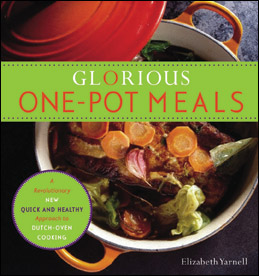
Glorious One-Pot Meals cookbookNo worries! This revolutionary cookbook is not going away: it’s being reincarnated! In January, 2009, Broadway Books (an imprint of Random House) will be releasing the revised and updated edition of Glorious One-Pot Meals!
This is very exciting news!

The Random House edition will contain twice as many recipes as the original cookbook, but it will lose the spiral binding which kept the book from flipping closed while you’re reading a recipe. It will also lose the Hale & Hearty, etc., designations for recipes as well as the photos.

All this means is that the current edition of Glorious One-Pot Meals, published by Pomegranate Consulting, LLC, is bound to be a collectors item!  🙂

It’s on sale for 10% off through the month of May, or while supplies last. From June – December, you may be able to find a copy from a reseller, but you won’t be able to purchase a signed book from the Glorious One-Pot Meals website.