Elizabeth Yarnell Amazon icon Audible icon Autographed icon Bluesky icon Book Bub icon Buffer icon Booksprout icon Buy Me a Coffee icon URL Copied! Copy URL Email icon Facebook icon Goodreads icon Headphones icon Home icon Instagram icon LinkedIn icon Linktree icon Mastodon icon Patreon icon Periscope icon Pinterest icon Reddit icon RSS icon Search icon Share icon Snapchat icon Threads icon TikTok icon Tumblr icon Twitter icon Vine icon Youtube icon Join a free Q/A Call!

Got Compost?

One of my friends recently started a backyard compost heap and raved to me about how much they’ve decreased their load at the curb on garbage day.

Welcome to the wonderful world of composting, I told her. Where you don’t have to feel guilty when a vegetable rots in your fridge before you have a chance to use it because you know it will get a second life creating rich new soil in your compost bin.

According to Denver’s 5280 magazine: Fifty-seven percent of Denverites’ garbage is organic material, which breaks down anaerobically (without air) inside plastic garbage bags at the landfill, creating methane, a greenhouse gas that can remain in the atmosphere for decades and exacerbate climate change.
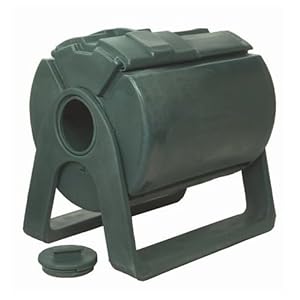
Rotating compost bin
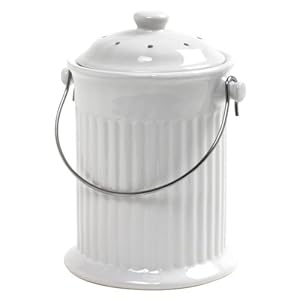
Countertop compost crock

Composting is as easy as keeping a lidded bin next to your sink. Instead of scraping non-meat table scraps down the in-sink disposal (and adding to the layer of sludge in the public sewer systems), divert anything that is non-animal product into the bin. When the bin is full, dump it into your main compost bin.
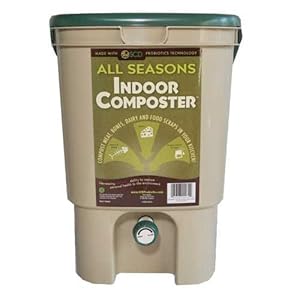
Indoor composter

You can get anything from an indoor composter to a suspended spinning barrel to something more like a corral. My husband built our first compost bin out of two-by-fours and metal fastenings from the hardware store that allowed the cross-boards to be louvered for air flow.
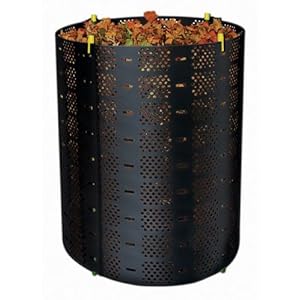
Round composting bin

The one we have now in our tiny, postage-stamp sized back yard is round.

There is a formula for composting as you add dried leaves, etc. to complete the mix. Here’s more info on composting.

The best part comes when you mix your homemade compost with soil and watch your plants thrive, although the satisfaction of greeting trash day with a single bag of non-organic refuse for the week comes close. 🙂

Physical Activity a Key to Later Health

Those who are physically active in their 50s and 60s are more likely to avoid chronic diseases and premature death, according to a study out of the Harvard School of Public Health.

The Nurses Health Study

Analyzing data from 13,535 female participants in the Nurses’ Health Study, researchers correlated reports of physical activity at the average age of 60 years with successful survival into the 70s. Successful survival was defined as “no history of ten major chronic diseases, or coronary artery bypass graft surgery and no cognitive impairment physical impairment, or mental health limitations.”

The correlation was considered strong enough to provide “evidence that higher levels of midlife physical activity are associated with exceptional health status among women who survive to older ages and corroborate the potential role of physical activity in improving overall health.”

Incorporate mental activity to your workout, adds neurologist Tim Vollmer, Co-Director of the Rocky Mountain MS Center Clinic, and keep your brain healthy along with your body.

Although repetitive actions like running are great for your cardiovascular system, coordinated arm leg movements like you find in yoga, pilates, dance, tennis, or my favorite, Jazzercise, can help keep all synapses firing.

Of course, you don’t need to wait until you hit midlife to get the benefits from regular physical and mental activity. The research shows that the old motto “Use it, or lose it!” has been proven to be true.

Exfoliation Better Than Meds for Facial Skin Eruptions and Acne

One of my friends recently took her 8-year old daughter in to see a dermatologist about the small white bumps that had appeared on her cheeks. I was horrified when she emerged with a prescription for Acutane.

Putting an 8-year old on Acutane, a serious acne medication whose side effects include photosensitivity (easily sunburned), depression, eating disorders, joint pain, seizures, cracked skin, and causes such severe birth defects that you must sign a waiver if you are of childbearing age (not that this 8-year old is likely to become pregnant, but this is one strong drug) is simply irresponsible, in my opinion.

Drugs.com says: Accutane is used to treat severe nodular acne. It is usually given after other acne medicines or antibiotics have been tried without successful treatment of symptoms. Acutane has been linked to Inflammatory Bowel Disease and may have other long term effects.

Truly, these little whitehead pimples don’t really even qualify as “acne”.

When I was 7 or 8, I noticed the same little white bumps splayed across my cheeks. My mother took me into the dermatologist, too. The difference was that my dermatologist recognized the benefits of exfoliation over medication for these little clogged pores.

He sent me home with my first Buf Puf and a recommendation to switch to Dove soap because it was less drying than the Ivory we had always used. I was to wash my face every night before bed and use the soapy Buf Puf to gently exfoliate my cheeks.

Lo and behold: no more white bumps!

Ok, this was in the 70s and soap technology has come a long way from Ivory and Dove, but the need to exfoliate remains. That visit to the doctor started me off early on caring for the skin on my face through daily exfoliation. As I got older I followed with a toner and moisturizer.

It’s still the same today, albeit with different products.

Aside from scattered, random clogged pores here and there, my face has always been smooth and blemish-free. That I’ve yet to find a wrinkle in my 40s I attribute to a combination of good genes and a lifetime of constant, dedicated skincare, including regular exfoliation.

Lately, we’ve noticed the same white bumps on my 7-year old son’s cheeks. I picked up a Buf Puf for him and taught him how to use it with a gentle, petroleum-free, fragrance-free soap. While he’s not a daily Buf Puffer yet, the once or twice a week that he uses it is enough to keep his cheeks smooth and bump-free. He may need to exfoliate more frequently as he enters his teens, but he already knows what to do and is accustomed to doing it.

All predictions point toward clear-skinned teen years and beyond if he keeps up this easy skincare routine.

Be sure to rinse your Buf Puf well, squeeze well, and allow to dry fully between uses to avoid mildew or bacterial growth. Replace frequently as needed.

Goat Cheese Good for Lactose Intolerance

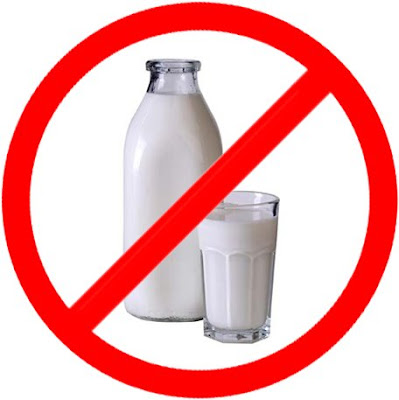
I wasn’t surprised when I noticed that I had become lactose-intolerant when I was 21. After all, my sister had been lactose-intolerant since birth and my mother had been off of milk since she made the connection in her years ago that milk products made her quite uncomfortable.

Bloating, gassiness, explosive diarreah, constipation, headache… these can all be symptoms of lactose intolerance, particularly if they show up within 1- 12 hours of ingesting a dairy product.

Lactose intolerance is not fun, to say the least. It’s particularly common among Mediterranean, Asian, African and other dark-skinned people, but can affect almost anyone.

It’s worth noting that mammals didn’t evolve to digest dairy products after weaning, and the human mammal is the only one to continue to drink milk as an adult. Really, lactose intolerance should be no surprise to any of us.

Still, life without cheese makes me feel deprived. Evolution didn’t account for the development of cheese.

Haystack Mountain Goat Dairy

Most lactose intolerant people simply avoid dairy products whenever possible. We can also take the lactase enzyme to help digest milk products on a food-by-food basis, but for me, even though lactase will ease the discomfort of digestion, I don’t believe it does everything it needs to because I notice a direct  correlation between when I consume cow’s milk products and weight gain in my own body.

Not so with goat milk products. Go figure.

Although goat’s milk has only slightly less lactose then cow’s milk (4.1% to 4.7%), something is different enough that many lactose-intolerant people don’t have a problem digesting it. Hooray! This discovery has opened up a whole new world for me and my family because we can have cheese again!

Some cheeses from Mt. Sterling Co-Op Creamery

The coolest part is finding how many products are now made with goat milk. Besides the typical soft Chevre log, we’ve found excellent Cheddar, Country Jack, and Mozzarella. Even our local Costco carries slices of unnamed goat cheese. Look for yogurt made from goat’s milk, too.

Colorado alone has more than 50 goat farms, dairies, and creameries. One of my favorites is the Haystack Mountain Goat Dairy — their cheeses are so delicious and special. Here’s a fun article about a program that puts prisoners to work on goat farms and then the goat milk goes to Haystack.

Mt. Sterling Creamery out of Wisconsin has wonderful harder goat cheeses, too.

(Do you get my newsletter? I send out a new Glorious One-Pot Meal recipe every other week exclusively to subscribers, and today’s recipe includes goat cheese!)

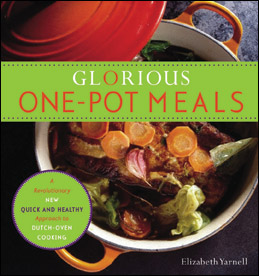
Glorious One-Pot Meals stovetop cooking method

Reader question:
I only have gas rings and no oven (but bought your book anyway as I like the idea); do you have any idea if I can use the recipes in a Dutch oven but by using the stove top rather than an oven?
– Kereebler, Dubai, United Arab Emirates

Hi Kereebler!

I’m psyched to learn my book has made it into the desert around the world! And yes, you can still prepare Glorious One-Pot Meals even if you don’t have a built-in oven.

An easy solution is to get a toaster oven that fits your Dutch oven. In the summertime, I plug my toaster oven in on my back porch and prepare my meals outside so as not to heat up my house.

However, one of my readers, Cas from Wyoming, discovered that GOPMs work just as well on the stovetop as in the oven.

This needs a little bit of advance prep to accomplish because you have to ascertain the temp of your stovetop. Start this on a night you do not plan to cook a GOPM.

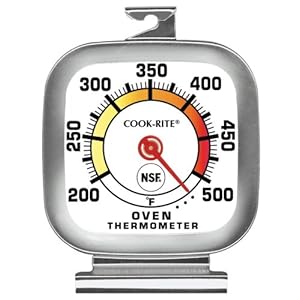
The first thing to do is set your empty cast iron Dutch oven on  your stovetop burner. Set an oven thermometer inside your empty pot, put the lid on and turn on the burner to medium. Check back in a few minutes to see what the thermometer reads. You may have to adjust the heat up or down for it to reach 450 F. When the heat inside the Dutch oven stabilizes at 450 degrees F, note the number on the dial of your burner, as this will be important.

Be sure to let the pot cool completely and remember that hot cast iron will crack if it comes into contact with cold water. If you are using an enameled cast iron Dutch oven,  you may see some minor scorching on the outside of the pot where it touches the burner. If you can live with this, you’re good to go.

When you are ready to cook, build your recipe in a room-temperature pot as written in the cookbook. You may want to use water instead of broth, if called for, as the fat in the broth may burn to the bottom of the pot. Otherwise, prepare you GOPM as normal. When the pot is full, place it on your burner and turn the dial to the number you noted earlier.

As when oven cooking your GOPMs, resist the urge to lift the lid before you smell the aroma of a fully-cooked meal wafting from the pot. It should take about 45 minutes to cook — the same as if you were oven cooking.

Don’t give up if your first try doesn’t come out perfectly; you may find that you prefer the way some ingredients turn out over others when you cook this way vs. in the oven.

Thanks, Cas, for figuring out this great work-around for those of us who are oven-less!

Although I have tested this stovetop method, and Cas has used it successfully for years in his rural cabin, it has not been extensively tested all over the world like the traditional GOPM oven method has been. Please let me know your results! Happy cooking!