Elizabeth Yarnell Amazon icon Audible icon Autographed icon Bluesky icon Book Bub icon Buffer icon Booksprout icon Buy Me a Coffee icon URL Copied! Copy URL Email icon Facebook icon Goodreads icon Headphones icon Home icon Instagram icon LinkedIn icon Linktree icon Mastodon icon Patreon icon Periscope icon Pinterest icon Reddit icon RSS icon Search icon Share icon Snapchat icon Threads icon TikTok icon Tumblr icon Twitter icon Vine icon Youtube icon Join a free Q/A Call!

Natural remedies for Eczema

I recently told you about a friend who returned from a trip to Mexico complaining about itchy, scaly skin on her palms. It quickly progressed to painful, bubbly sores with peeling skin. A visit to the dermatologist diagnosed eczema.

My friend was quite surprised as she hadn’t ever had any eczema patches before on her body, so she knew she wasn’t prone to it. But during her vacation, she was so concerned with keeping her preschooler healthy that she may have overused sanitizer during the week. The drying effect of the alcohol combined with the disinfecting chemicals in the product had severely irritated her skin.

Here’s a natural hand sanitizer she might want to try next time to avoid this problem. But in the meantime, she still had to do something to heal her hands.

The doctor prescribed an anti-inflammatory cortisone cream and vasoline to hold moisture into the skin. Of course, I immediately suggested less toxic alternatives for her.

Instead of a steroidal cortisone cream, I like to use Florasone, a homeopathic anti-inflammatory cream that helps reduce inflammation, provide soothing and healing, and help rebalance the imbalance that is causing the problem in the first place.  I’ve successfully used Florasone for reducing the itching from hives and other skin irritations, including bug bites and cold sores. Because it is homeopathic, you can feel safe about using it as frequently as needed and even on infants.

It only takes a knowledge of the full title of Vasoline Petroleum Jelly to know where it comes from and that I don’t want it anywhere near my body. I certainly don’t want it to absorb through my skin. Instead, for adding moisture into the skin, we have not found anything better for providing immediate relief than Weleda Skin Food. Love this stuff; it’s very powerful.

To promote healing of cracked skin, try mixing a drop or two of antibacterial Tea Tree oil with a carrier oil, such as pure Almond oil, on the affected skin. I like NOW almond oil because it doesn’t contain any vitamin E, which can be an allergen for some people with eczema.

Natural Hand Sanitizer

My friend recently returned from a trip to Mexico complaining about itchy, scaly skin on her palms. It quickly progressed to painful, bubbly sores with peeling skin. A visit to the dermatologist diagnosed eczema.

During her vacation, she was so concerned with keeping her preschooler healthy that she may have overused sanitizer during the week. The drying effect of the alcohol combined with the disinfecting chemicals in the product had severely irritated her skin.

I confess that I am a fan of using sanitizers after visiting public places and before eating food. You might even call me anal about it, but when you can’t wash your hands, sanitizer can be the next best thing.

As far as sanitizer goes, my favorite brand is EO, a family-owned and operated, certified organic manufacturer.

I find the EO Santizing Spray to be less toxic and less drying than conventional-brand sanitizers. The fragrance is light and clean, rather than cloying and chemical, and I don’t have to worry about accidently eating sanitizer residue because it is all natural.

Creativity in the Kitchen

What do you do if you are in the midst of preparing a recipe and you discover you’re missing one ingredient?

This is what happened to my fabulous coach Rachelle Disbennett-Lee’s husband, Adrian, the other day.

Now that Adrian is retired, he will be taking over more of the household duties, including shopping for and making meals when Rachelle is working late. Luckily, they have been Glorious One-Pot Meals fans for years, so this part should be a slam dunk. Right?

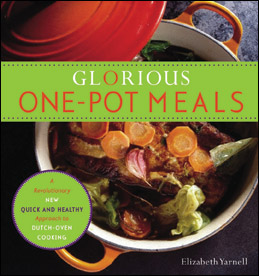
Glorious One-Pot Meals coverOn his first night as the official “chef,” Adrian selected a recipe (Pasta Primavera) and went to the grocery store to collect the ingredients. He came home and began to assemble the meal. Halfway through, he hit a stumbling block: instead of a jar of artichoke hearts, he had mistakenly purchased marinated garlic cloves! Uh-oh!

Oblivious to this crisis, Rachelle was working away in her office, looking forward to the wafting aroma that would tell her dinner was ready — a dinner she didn’t have to cook!

Poor Adrian! His lack of experience and confidence in the kitchen thwarted him, and when Rachelle emerged after her conference call, sniffing expectantly, he suggested they go out to T.G.I.F. for dinner. Becuase he didn’t have the artichoke hearts, he felt he could not move forward and complete the recipe. His first attempt at dinner was a flop!

Now, now, Rachelle soothed. What else do we have in the house that we can use instead of artichoke hearts? With Glorious One-Pot Meals, you can freely adjust any recipe to include or avoid any ingredients. Don’t have artichoke hearts? How about spinach, cabbage, or kale? She ended up adding some carrots and spinach leaves to the pot, as well as using some of those marinated garlic cloves (yum!) and rescuing the meal.

As a cookbook author, this incident provided a good reminder for me that many people lack confidence in the kitchen and believe they must follow a recipe to the letter when cooking. Let me take this opportunity to assure my readers that this is not the case when you’re cooking Glorious One-Pot Meals! You should feel free to substitute, add, or subtract any item(s) from a recipe at any time, and still be assured of creating a delicious meal.

Life is too short to be scared in the kitchen. Live passionately, eat heartily, and cook with abandon!

How natural are “natural flavors”?

I’m always wary when I see a listing for “natural flavors” on an ingredient list. If it’s so natural, why don’t they just say “vanilla beans,” or “cola beans,” or “strawberries.” Because you often won’t find any trace of anything natural in an ingredient list for “natural flavors,” that’s why.

My friend, Nonna Joann Bruso, publishes an informative little e-zine about raising healthy eaters called “Baby Bites.” In her latest issue she lists all the ingredients that make up the “natural flavors” in a strawberry milkshake. Let me reprise it here for you:

Amyl acetate, amyl butyrate, amyl valerate, anethol, anisyl formate, benzyl acetate, benzyl isobutyrate, butyric acid, cinnamyl isobutyrate, cinnamyl valerate, cognac essential oil, diacetyl, dipropyl ketone, ethyl acetate, ethyl amyl ketone, ethyl butyrate, ethyl cinnamate, ethyl heptanoate, ethyl heptylate, ethyl lactate, ethyl methylphenylglycidate, ethyl nitrate, ethyl propionate, ethyl valerate, heliotropin, hydroxyphenyl-2-butanone (10 percent solution in alcohol), a-ionone, isobutyl anthranilate, isobutyl butyrate, lemon essential oil, maltol, 4-methylacetophenone, methyl anthranilate, methyl benzoate, methyl cinnamate, methyl heptine carbonate, methyl naphthyl ketone, methyl salicylate, mint essential oil, neroli essential oil, nerolin, neryl isobutyrate, orris butter, phenethyl alcohol, rose, rum ether, g-undecalactone, vanillin, and solvent.

Bleeeeeeech!

Why oh why do companies think they can improve on nature by substituting natural foods for a  compound of more than 50 chemicals and derivatives? You’d think it would be a lot more work to develop this mixture than it would be just to do something really radical, like blend up some strawberries?

But even more horrifying to me is the utter lack of regard for the consumer of these chemical mixes. These ingredients include petroleum byproducts commonly used in products like nailpolish, tanning oils, perfumes, etc… Some of these ingredients, like butyric acid, are known to be cancer-causing, yet they are still included in this “natural” strawberry flavoring.

Even vanillin is synthesized in a petrochemical plant in China or Louisiana to mimic the flavor of real vanilla. Without the real vanilla, of course.

You can argue that you might receive a really small amount of these substances in a single strawberry milkshake. Maybe. But add up all the things you might be eating every day that contain artificial or “natural” flavors and colors, and that’s a lot of toxins to accumulate in your body. Soda pop, snack cakes, cheese-flavored crackers, maple-flavored syrups, mainstream ice creams, cereals, juices… need I go on?

My goal is always to stick to whole foods as much as possible to avoid these hidden killers, but when I do purchase prepared foods I look for labels that list fewer ingredients where all of them are easily identifiable. Unfortunately, the FDA allows companies to hide that ugly list above under the catch-all ingredient of “natural flavors.”

Now you know, though, and you won’t be fooled so easily.

African Rooibos Tea

Have you tried African Rooibus Bush teas? I confess that they are my newest addiction.

I’ve been a dedicated tea drinker for most of my life. Black tea, green tea, herbal tea… you name it, I probably drink it. Well, truth be told, I don’t enjoy spicy teas, like chai, but otherwise I love to sip a hot or cold infusion of leaves, flowers, herbs, or berries no matter what the weather.

The last decade or so, since I was diagnosed with MS, I’ve become increasingly less tolerant of caffeine, which has unfortunately limited my choices in teas. So I’m always excited to find a new tea that is caffeine-free and delicious to beat.

My new favorite decaffeinated teas are from an inspiring little tea company called Numi Teas. You may have seen one of their countertop variety dispensers at some of the cooler coffee shops around town — they have a whole line of yummy teas  — but the ones that have enraptured me at this moment are the African Rooibos Teas: Organic Red Mellow Bush and Sweet African Red Green Rooibos.

I don’t know about you, but it took me a while to get up the nerve to try a Rooibos tea. I had no idea what it would taste like, although I remembered that Precious Mambotswe drank it all the time in the fun series The No. 1 Ladies Detective Agency . But, of course, those stories take place in Africa, hence why they drink bush tea.

But still, I was curious. What did “bush tea” taste like? So I tried it.

And, it was good. Really good. Rich and earthy, mellow with some body. The red bush tea is more robust with a stronger, heartier mouth-feel and body than the more delicate green variety. I like to sweeten both with a bit of Agave nectar as it really brings the rooibos flavors to the forefront.

And now I’m seriously addicted to Rooibos. Haven’t touched a cup of green tea in months. Luckily, Rooibos is as high — or higher — in antioxidents as green tea, so this is one addiction that is guilt-free.

So, take a plunge and try something new with a rooibos bush tea. You’ll be glad you did.