Elizabeth Yarnell Amazon icon Audible icon Autographed icon Bluesky icon Book Bub icon Buffer icon Booksprout icon Buy Me a Coffee icon URL Copied! Copy URL Email icon Facebook icon Goodreads icon Headphones icon Home icon Instagram icon LinkedIn icon Linktree icon Mastodon icon Patreon icon Periscope icon Pinterest icon Reddit icon RSS icon Search icon Share icon Snapchat icon Threads icon TikTok icon Tumblr icon Twitter icon Vine icon Youtube icon Join a free Q/A Call!

Itchy genitals, itchy rectum remedies

On a rather awkward topic, I am working with a client complaining about an itchy butt.

Itching in the genital areas can be due to irritation from wiping after toileting to dermatitis, parasites, food sensitivities, or infections. Here are some suggestions for home treatments to stop that itching between your legs:

  • Use only unscented, dye-free toilet paper, or better yet, a bidet.
  • Wear cotton underpants during the day and sleep without underwear.
  • Stop using soap on your genitals. Virgin coconut oil is a better choice for cleansing and moisturizing delicate mucous-producing areas.
  • Take a sitz bath. Dissolve 1-2 cups of Epsom Salts in a bath tub of warm water and sit and soak for twenty minutes at a time.
  • Keep the area clean and dry. Dust with cornstarch to absorb sweat during times of need.
  • Switch to organic tampons and sanitary napkins. The bleaching agents and synthetic fibers in conventional brands can be irritating.
  • Adjust your birth control. Switch brands of lube or condoms — many spermicides can cause itchiness. Have your IUD checked. You may be reacting to your lover’s sperm, which could be solved by using condoms. Talk to your doctor about trying a different birth control pill.
  • Check for worms. Just before bed, stretch a piece of cellophane tape (Scotch tape) across your opened anus. Remove tape in the morning and check for eggs or worms. If any are found, present tape to a G.I. specialist for worming medication.
  • Inspect the itching with a mirror. Does it look like a rash? Does it come and go? Is there a concentric circle of inflammation around the anus? It could be a hypersensitivity reaction to a food you are eating. Keep a food diary or consider testing for food sensitivities.
  • Assess for a vaginal yeast infection. Do you have excessive, cheesy discharge along with itching and burning? Swab a cotton ball soaked in hydrogen peroxide across your labia; if it fizzes, that indicates yeast. You may douche with a combination of 3% hydrogen peroxide (available at any drugstore) and water or use an over-the-counter topical yeast treatment for a few days to kill the yeast, and be sure to take plenty of probiotics to assure a healthy regeneration of the vaginal environment.

If the itching continues or you see wart-like bumps, consider getting tested for Sexually Transmitted Infections (STIs). Your local Planned Parenthood can do this quickly and anonymously, if needed. Additionally, some oral medications may provoke itching in the rectum. Talk to your doctor or pharmacist to determine if this could be a side effect from another drug or a drug interaction.

Let me know if you have any remedies I might have missed by leaving them in the comments below!

How to read UPC codes for organic produce

Did you know those PLU codes on produce at the grocery store can be deciphered to give you clues as to what you are buying? Organic, conventionally-grown, and even genetically modified foods (GMO) should follow the produce labeling system.

According to the Organic Food Coupons blog, here’s how to read the codes:

  • PLU numbers on conventionally grown foods should have only 4 digits and begin with 4, for example: 4131
  • PLU codes for organically grown produce will contain 5 digits and begin with 9: 91022
  • PLU codes on genetically modified items should contain 5 digits and begin with 8: 81022

Here are some PLU examples:
Fuji Apples
#94129 Organic
#4131 Conventional

Granny Smith Apples
#94017 organic
#4017 conventional

Gala Apples
#94133 Organic
#4133 Conventional

Unfortunately, you can’t depend on knowing that the food is genetically engineered/modified (GMO) just by looking for the 8 at the beginning of the PLU code. Here’s what the Organic Food Coupons Blog has to say about it:

Initially in 1992 when the bio tech companies thought that we would all
wanted to eat their altered food they wanted to have a new “code” so that we
could all see which food was the altered and would buy it up- ya right! So
they adopted the number 8 to appear in front of their products. Quickly the
industry learned that not only do we NOT want the GMO foods we will
purposely not purchase foods that have been altered they no longer use the number
“8” as part of the code. The only GMO product that still used the “8” code
is Hawaiian papaya.

The only foods that you can be sure are not GMO foods are labeled
“Certified Organic”. Organic producers must follow strict rules to be able to label
their products as organic. Interesting or disturbingly enough the
companies producing the GMO (chemically altered foods) do not have labeling
restrictions- Crazy! Anything else is fair game unfortunately- pay special
attention to products that have corn, cotton seed or soy they may have GMO
origins.

As always, it’s up to you to pay attention if you are intent on eating clean, wholesome foods.

Food triggers for pollen allergies

Bryce Wylde, Canada’s most popular alternative medicine expert, says that sufferers of allergies to airborne pollens may also be affected by eating certain foods. We know there is a cross-over of pollen within botanical families, and that sometimes being sensitive to one member of the family also means loss of tolerance to other members of the same plant family. If you know you are sensitive to these pollens, it may be helpful to avoid the related foods as well. Here’s the list:

Alder pollen: almonds, apples, celery, cherries, hazel nuts, peaches, pears, parsley, strawberry, raspberry

Birch pollen: almonds, apples, apricots, avocados, bananas, carrots, celery, cherries, chicory, coriander, fennel, fig, hazel nuts, kiwifruit, nectarines, parsley, parsnips, peaches, pears, peppers, plums, potatoes, prunes, soy, strawberries, wheat; Potential: walnuts

Grass pollen: fig, melons, tomatoes, oranges

Mugwort pollen: carrots, celery, coriander, fennel, parsley, peppers, sunflower

Ragweed pollen: banana, cantaloupe, cucumber, green pepper, paprika, sunflower seeds/oil, honeydew, watermelon, zucchini, echinacea, artichoke, dandelions, honey (if bees pollinate from wild flowers), hibiscus or chamomile tea

If the flowering trees and grasses have been making you miserable this spring, you might want to try a homeopathic hayfever remedy. It’s safe for all ages, won’t interact with any medicines, and doesn’t have side effects. Usually one to three doses per season are all that’s required for relief from itchy eyes, foggy head, sneezing and constant runny nose.

Could Mental Illness Really Be A Vitamin Deficiency?

Dr. Mercola writes about the overuse of antipsychotic medications and their frightening side effects as a prelude to introducing Dr. Andrew Saul and his new book, Niacin: The Real Story: Learn about the Wonderful Healing Properties of Niacin.

According to Dr. Mercola, Dr. Saul co-wrote the book with Abram Hoffer  M.D., Ph.D., who published over 600 reports and articles as well as 30 books. “His early work led to the use of niacin for schizophrenia and as an cholesterol treatment. Dr. Hoffer died in 2009 at the age of 91, but he successfully treated many thousands of patients with high dose niacin for  psychotic disorders. He presented some very compelling evidence to support treating most psychotic disorders as a vitamin B3 deficiency.”

Those B vitamins may be more important than we had realized to maintaining a healthy state, mentally and emotionally as well as physically.

Vitamin B3 (niacin) helps the body process fats and stabilize blood sugar and cholesterol. Niacin deficiencies may appear as general weakness, skin infections, digestive problems or lack of appetite. And, apparently, lack of niacin can manifest as psychiatric symptoms.

It wouldn’t hurt to increase your intake of vitamin B3 if you are struggling with mental illness. Foods that are highest in vitamin B3 (niacin) include crimini mushrooms, shiitake mushrooms, chicken, and tuna. Other sources include salmon, chicken breast, asparagus, halibut, venison, calf’s liver, and turkey.

What Healthy Poop Looks Like

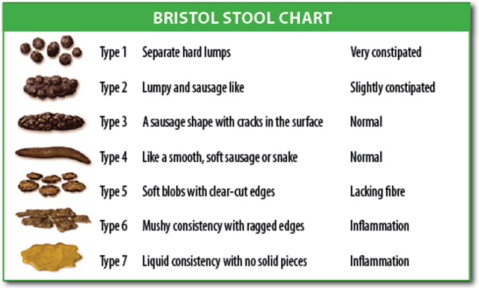
My practice as a naturopath focuses on balancing nutrition and identifying and eliminating inflammatory foods to restore health, and I always inquire about my patients’ elimination habits. bristol stool scale for determinng healthy poopThe state of someone’s stool says a lot about their internal processes, i.e.,  if they are absorbing their foods, suffering from inflammation, and/or infected by parasites. I ask about color, odor, buoyancy, frequency, ease, and consistency. One of the tools I use to assess the responses is the Bristol Stool Chart.
Developed at the University of Bristol in England, and published in the Scandanavian Journal of Gastroenterology in 1997, the Bristol Stool Chart describes the consistency and form of human poop ranging from diarrhea to constipation. It’s a clinical tool you can use to assess your own health on a daily basis.

The optimum state for stool is Type 4. I think of it as when your poop looks like an old banana: smooth and tubular with a slight curve and gentle to pass.

One of my mentors, Dr. Tom Anstett, jokes that he is the president of SWA, or Stool Watchers of America. He knows that your stool is a good indicator of how the rest of your body is doing: healthy stool means all systems are fired and functioning.

Are you noticing that you do not eliminate Type 4 poop 1-3 times per day? Sophisticated testing and dietary therapies can help get you back on track and feeling good. Contact me if you’d like a free consultation.